
|
You entered: LMC
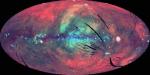 ROSAT Explores The X-Ray Sky
19.08.2000
Launched in 1990, the orbiting ROSAT observatory explored the Universe by viewing the entire sky in x-rays -- photons with about 1,000 times more energy than visible light. This ROSAT survey produced the sharpest, most sensitive image of the x-ray sky to date.
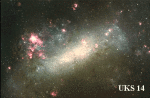 The Large Cloud of Magellan
18.09.1995
Magellan and his crew had plenty of time to study the southern sky during their famous voyage around the world. As a result, two fuzzy cloud like objects, nestled among the southern constellations of Doradus and Tucana are now known as the Clouds of Magellan.
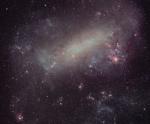 The Large Cloud of Magellan
2.09.2004
Portuguese navigator Fernando de Magellan and his crew had plenty of time to study the southern sky during the first circumnavigation of planet Earth. As a result, two fuzzy cloud-like objects easily visible for southern hemisphere skygazers are known as the Clouds of Magellan.
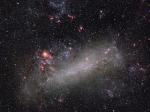 The Large Cloud of Magellan
10.05.2006
Portuguese navigator Fernando de Magellan and his crew had plenty of time to study the southern sky during the first circumnavigation of planet Earth. As a result, two fuzzy cloud-like objects easily visible for southern hemisphere skygazers are known as the Clouds of Magellan.
 The Tarantula Zone
26.04.2008
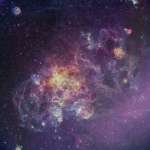
The Tarantula Nebula is more than 1,000 light-years in diameter -- a giant star forming region within our neighboring galaxy the Large Magellanic Cloud (LMC). That cosmic arachnid lies at the upper left of this expansive mosiac covering a part of the LMC over 6,000 light-years across.
 The Tarantula Zone
16.09.2009
The Tarantula Nebula is more than 1,000 light-years in diameter -- a giant star forming region within our neighboring galaxy the Large Magellanic Cloud (LMC). That cosmic arachnid lies left of center in this in this colorful telescopic image taken through narrow-band filters. It covers a part of the LMC over 2,000 light-years across.
 NGC 1818: A Young Globular Cluster
11.03.2001
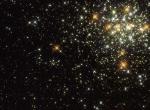
Globular clusters once ruled the Milky Way. Back in the old days, back when our Galaxy first formed, perhaps thousands of globular clusters roamed our Galaxy. Today, there are perhaps 200 left. Many globular clusters were destroyed over the eons by repeated fateful encounters with each other or the Galactic center.
 NGC 1818: A Young Globular Cluster
29.12.2002
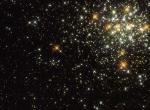
Globular clusters once ruled the Milky Way. Back in the old days, back when our Galaxy first formed, perhaps thousands of globular clusters roamed our Galaxy. Today, there are perhaps 200 left. Many globular clusters were destroyed over the eons by repeated fateful encounters with each other or the Galactic center.
 Small Galaxy NGC 4449
3.05.2007
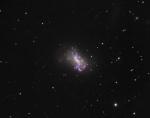
Grand spiral galaxies often seem to get all the glory. Their newly formed, bright, blue star clusters along beautiful, symmetric spiral arms are guaranteed to attract attention. But small irregular galaxies form stars too, like NGC 4449, located about 12 million light-years away.
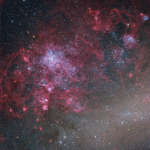 The Tarantula Zone
12.06.2014
The Tarantula Nebula is more than 1,000 light-years in diameter, a giant star forming region within our neighboring galaxy the Large Magellanic Cloud (LMC). That cosmic arachnid lies toward the upper left in this deep and colorful telescopic view made through broad-band and narrow-band filters.
|
January February March April May June July August September |
|||||||||||||||||||||||||||||||||||||||||||||||||