
|
You entered: Earth's atmosphere
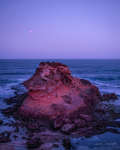 Red Planet Red Moon and Mars
9.08.2018
Mars is also known as The Red Planet, often seen with a reddish tinge in dark night skies. Mars shines brightly at the upper left of this gorgeous morning twilight view from Mornington Peninsula, Victoria, Australia, but the Moon and planet Earth look redder still. Taken on July 27, the totally eclipsed Moon is setting.
 Moon Pi and Mountain Shadow
14.03.2024
What phase of the Moon is 3.14 radians from the Sun? The Full Moon, of course. Even though the Moon might look full for several days, the Moon is truly at its full phase when it is Pi radians (aka 180 degrees) from the Sun in ecliptic longitude.
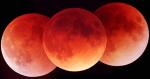 A Lunar Eclipse in Three Exposures
25.01.2000
Our Moon turned red last week. The reason was that during the night of January 20, a total lunar eclipse occurred. The above digitally superimposed photographs captured the Moon three times during this lunar...
 Blue Ghost s Diamond Ring
19.03.2025
On March 14 the Full Moon slid through Earth's dark umbral shadow and denizens of planet Earth were treated to a total lunar eclipse. Of course, from the Moon's near side that same astronomical syzygy was seen as a solar eclipse.
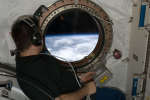 Home from Above
30.12.2008
There's no place like home. Peering out of the window of the International Space Station (ISS), astronaut Greg Chamitoff takes in the planet on which we were all born. About 350 kilometers up, the ISS is high enough so that the Earth's horizon appears clearly curved.
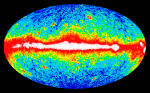 Gamma Ray Sky Map
23.06.1995
What if you could "see" gamma rays? This computer processed image represents a map of the entire sky at photon energies above 100 million electron Volts. These gamma-ray photons are more than 40 million times more energetic than visible light photons and are blocked from the Earth's surface by the atmosphere.
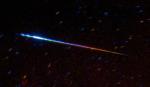 A Perseid Meteor
11.08.1997
Tonight the Perseid Meteor Shower reaches its maximum. Grains of rocky ice will streak across the sky as they evaporate during entry into Earth's atmosphere. These ice chips were shed from Comet Swift-Tuttle. The Perseids result from the annual crossing of the Earth through Comet Swift-Tuttle's orbit.
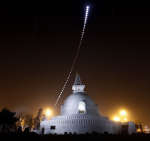 A Lunar Eclipse Over an Indian Peace Pagoda
14.12.2011
Our Moon turned red last week. The reason was that during December 10, a total lunar eclipse occurred. The above digitally superimposed image mosaic captured the Moon many times during the eclipse, from before the Moon entered Earth's shadow until after the Moon exited.
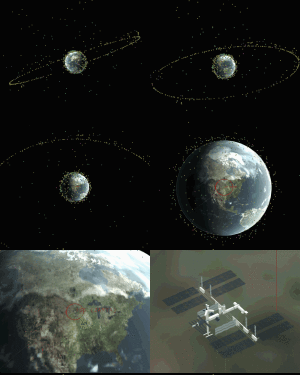 The Satellites that Surround Earth
14.07.2003
Thousands of satellites orbit the Earth. Costing billions of dollars, this swarm of high altitude robots is now vital to communication, orientation, and imaging both Earth and space. One common type of orbit is geostationary where a satellite will appear to hover above one point on Earth's equator.
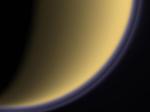 The Double Haze above Titan
10.08.2004
Most moons have no haze layer at all - why does Titan have two? Images from the Cassini spacecraft that slipped into orbit around Saturn last month confirm that the Solar System's most mysterious moon is surrounded not only by a thick atmosphere but also by two distinct spheres of haze.
|
January February March April May June July August |
||||||||||||||||||||||||||||||||||||||||||||||||||||||||