
|
You entered: hot gas
 Temperatures on Exoplanet WASP 43b
3.05.2024
A mere 280 light-years from Earth, tidally locked, Jupiter-sized exoplanet WASP-43b orbits its parent star once every 0.8 Earth days. That puts it about 2 million kilometers (less than 1/25th the orbital distance of Mercury) from a small, cool sun.
 Star Cluster R136 Bursts Out
6.05.2007
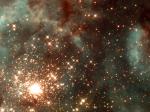
In the center of star-forming region 30 Doradus lies a huge cluster of the largest, hottest, most massive stars known. These stars, known as the star cluster R136, and part of the surrounding nebula are captured here in this gorgeous visible-light image from the Hubble Space Telescope.
 Star Cluster R136 Bursts Out
24.01.2016
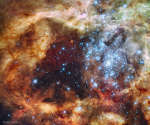
In the center of star-forming region 30 Doradus lies a huge cluster containing some of the largest, hottest, and most massive stars known. These stars, known collectively as star cluster R136, were captured in the featured image in visible light by the Wide Field Camera 3 in 2009 peering through the Hubble Space Telescope.
 R136: The Massive Stars of 30 Doradus
11.12.2005
In the center of star-forming region 30 Doradus lies a huge cluster of the largest, hottest, most massive stars known. These stars, known as the star cluster R136, and part of the surrounding nebula are captured here in this gorgeous visible-light image from the Hubble Space Telescope.
 Star Cluster R136 Bursts Out
29.07.2012
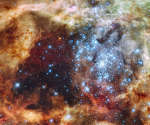
In the center of star-forming region 30 Doradus lies a huge cluster of the largest, hottest, most massive stars known. These stars, known collectively as star cluster R136, were captured above in visible light by the newly installed Wide Field Camera peering though the recently refurbished Hubble Space Telescope.
 N44C: A Nebular Mystery
14.05.2002
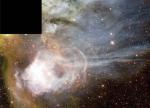
Why is N44C glowing so strangely? The star that appears to powers the nebula, although young and bright, does not seem hot enough to create some of the colors observed. A search for a hidden hotter star in X-rays has come up empty.
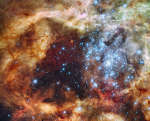 Star Cluster R136 Bursts Out
21.12.2009
In the center of star-forming region 30 Doradus lies a huge cluster of the largest, hottest, most massive stars known. These stars, known collectively as star cluster R136, were captured above in visible light by the newly installed Wide Field Camera peering though the recently refurbished Hubble Space Telescope.
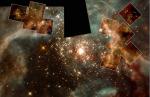 Massive Stars Of 30 Doradus
30.09.1999
This gorgeous visible-light Hubble Space Telescope image shows a young cluster of massive stars at the center of the 30 Doradus Nebula. Gas and dust clouds in 30 Doradus, also known as the Tarantula Nebula, have been sculpted into elongated shapes by powerful winds and ultraviolet radiation from these hot cluster stars.
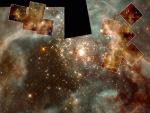 Massive Stars of 30 Doradus
22.06.2003
In the center of star-forming region 30 Doradus lies a huge cluster of the largest, hottest, most massive stars known. These stars and part of the surrounding nebula are captured here in this gorgeous visible-light Hubble Space Telescope image.
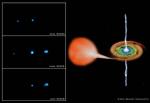 The X Ray Jets of XTE J1550
8.10.2002
The motion of ultra-fast jets shooting out from a candidate black hole star system have now been documented by observations from the orbiting Chandra X-ray Observatory. In 1998, X-ray source XTE J1550-564 underwent a tremendous outburst.
|
January February March April May June July August September |
|||||||||||||||||||||||||||||||||||||||||||||||||