
|
You entered: dust
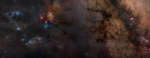 Dark River Wide Field
19.07.2010
A Dark River of dust seems to run from our Galactic Center, then pool into a starfield containing photogenic sky wonders. Scrolling right will reveal many of these objects including (can you find?)...
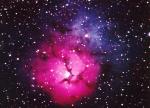 The Trifid Nebula in Red, White and Blue
8.12.1997
Three dark dust lanes give the picturesque Trifid Nebula its name. The red and blue colors of the Trifid Nebula are present in different regions and are created by different processes. A big bright star near the center of the red region appears white hot and emits light so energetic
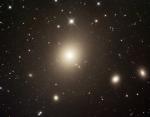 Elliptical Galaxy M87
20.05.2006
In spiral galaxies, majestic winding arms of young stars and interstellar gas and dust rotate in a flat disk around a bulging galactic nucleus. But elliptical galaxies seem to be simpler. Lacking gas and dust to form new stars, their randomly swarming older stars, give them an ellipsoidal (egg-like) shape.
 APOD: 2024 February 6 Б NGC 1566: A Spiral Galaxy from Webb and Hubble
6.02.2024
What's different about this galaxy? Very little, which makes the Spanish Dancer galaxy, NGC 1566, one of the most typical and photogenic spirals on the sky. There is something different about this galaxy...
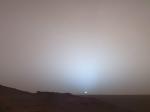 Sunset Over Gusev Crater
20.06.2005
What would it be like to see a sunset on Mars? To help find out, the robotic rover Spirit was deployed last month to park and serenely watch the Sun dip below the distant lip of Gusev crater. It was a tough job, but some robot had to do it.
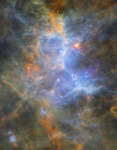 Herschel s Eagle Nebula
28.07.2016
A now famous picture from the Hubble Space Telescope featured Pillars of Creation, star forming columns of cold gas and dust light-years long inside M16, the Eagle Nebula. This false-color composite image views...
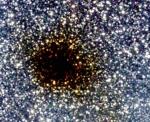 Dark Cloud
26.02.1999
Ominously foreshadowing events to come, a dark cloud of obscuring dust stands out against a luminous star field in the Milky Way. Cataloged as Feitzinger and Stuwe object "1-457" this fuliginous interstellar nebula is relatively close - possibly only 1,000 light-years distant.
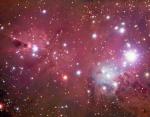 The Mysterious Cone Nebula
7.01.2002
Sometimes the simplest shapes are the hardest to explain. For example, the origin of the mysterious cone-shaped region seen on the far left remains a mystery. The interstellar formation, dubbed the Cone Nebula, is located about 2700 light years away.
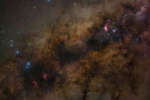 Sagittarius and the Central Milky Way
19.05.2009
What does the center of our Milky Way Galaxy look like? In visible light, no one knows! It is not possible to see the Galactic center in light our eyes are sensitive to because the thick dust in the plane of our Galaxy obscures it.
 Journey to the Center of the Galaxy
21.01.1997
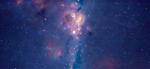
In Jules Verne's science fiction classic A Journey to the Center of the Earth, Professor Hardwigg and his fellow explorers encounter many strange and exciting wonders. What wonders lie at the center of our Galaxy?
|
January February March April May June July August September |
|||||||||||||||||||||||||||||||||||||||||||||||||