
|
You entered: dark
 Solar Eclipse from Western Australia
21.04.2023
Along a narrow path that mostly avoided landfall, the shadow of the New Moon raced across planet Earth's southern hemisphere on April 20 to create a rare annular-total or hybrid solar eclipse.
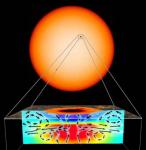 Under A Sunspot
8.11.2001
At the Sun's surface, sunspots are known to be dark, planet-sized regions of intense magnetic fields. But what lies below? Using observations from the Michelson Doppler Imager (MDI) instrument aboard the space-based SOHO observatory, astronomers have derived this premier picture of the flow of material just beneath a visible sunspot.
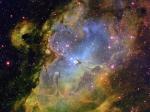 Inside the Eagle Nebula
26.02.2006
From afar, the whole thing looks like an Eagle. A closer look at the Eagle Nebula, however, shows the bright region is actually a window into the center of a larger dark shell of dust. Through this window, a brightly-lit workshop appears where a whole open cluster of stars is being formed.
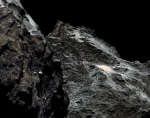 62 Kilometers above Comet Churyumov Gerasimenko
15.09.2014
Spacecraft Rosetta continues to approach, circle, and map Comet Churyumov-Gerasimenko. Crossing the inner Solar System for ten years to reach the vicinity of the comet last month, the robotic spacecraft continues to image the unusual double-lobed comet nucleus. The reconstructed-color image featured, taken about 10 days ago, indicates how dark this comet nucleus is.
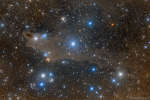 The Shark Nebula
7.09.2015
There is no sea on Earth large enough to contain the Shark nebula. This predator apparition poses us no danger, though, as it is composed only of interstellar gas and dust. Dark dust like that featured here is somewhat like cigarette smoke and created in the cool atmospheres of giant stars.
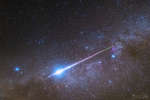 Bright Meteor, Starry Sky
19.08.2021
Plowing through Earth's atmosphere at 60 kilometers per second, this bright perseid meteor streaks along a starry Milky Way. Captured in dark Portugal skies on August 12, it moves right to left through the frame.
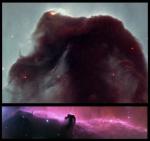 Horsehead Rides Again
26.04.2001
Difficult to see in small telescopes, the Horsehead nebula was recently selected by internet voters as a target for the Hubble Space Telescope. Above (top) is Hubble's detailed view of the dark cosmic dust cloud, released to celebrate the 11th anniversary of the workhorse orbiting observatory.
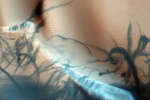 Martian Dust Devil Trails
21.10.2009
Who's been marking up Mars? This portion of a recent high-resolution picture from the HiRISE camera on board the Mars Reconnaissance Orbiter shows twisting dark trails criss-crossing light colored terrain on the martian surface.
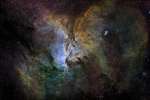 Shaping NGC 6188
2.05.2008
Dark shapes with bright edges winging their way through dusty NGC 6188 are tens of light-years long. The emission nebula is found near the edge of an otherwise dark large molecular cloud in the southern constellation Ara, about 4,000 light-years away.
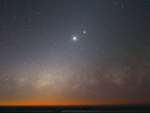 Chilean Skyscape
29.11.2008
Night skies over Chilean mountain top observatories can be dark and clear, with glorious cosmic vistas. In this recent example, the plane of our Milky Way galaxy stretches parallel to the horizon, the galactic center's star clusters, dark dust clouds, and glowing nebulae hovering in the west.
|
January February March April May June July August September |
|||||||||||||||||||||||||||||||||||||||||||||||||