
|
You entered: Solar System
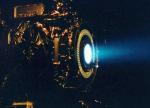 An Ion Drive for Deep Space 1
26.10.1998
Space travel entered the age of the ion drive Saturday with the launch of Deep Space 1, a NASA mission designed primarily to test new technologies. Deep Space 1 is bound for asteroid 1992 KD in July 1999.
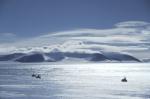 Searching for Meteorites in Antarctica
26.12.2002
Where is the best place on Earth to find meteorites? Although meteors fall all over the world, they usually just sink to the bottom of an ocean, are buried by shifting terrain, or are easily confused with terrestrial rocks.
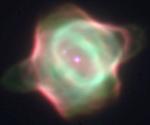 Hen 1357: New Born Nebula
3.04.1998
This Hubble Space Telescope picture shows Hen-1357, the youngest known planetary nebula. Graceful, gentle curves and symmetry suggest its popular name - The Stingray Nebula. Observations in the 1970s detected no nebular material, but this image from March 1996 clearly shows the Stingray's emerging bubbles and rings of shocked and ionized gas.
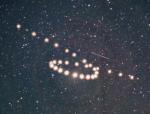 Retrograde Mars
16.12.2003
Why would Mars appear to move backwards? Most of the time, the apparent motion of Mars in Earth's sky is in one direction, slow but steady in front of the far distant stars. About every two years, however, the Earth passes Mars as they orbit around the Sun.
 Mysterious Pluto and Charon
9.04.2000
Pluto is the only planet in our Solar System remaining unphotographed by a passing spacecraft. Distant Pluto and its moon Charon therefore remain somewhat mysterious. In addition to direct imaging by the Hubble Space...
 NEAR to Asteroid Eros
5.02.2000
On December 23, 1998 the Near Earth Asteroid Rendezvous (NEAR) spacecraft flew by asteroid 433 Eros. The robotic spacecraft was intended to brake and orbit Eros, but an unexpected shutdown of its main engine caused this plan to be aborted.
 Comet McNaught Over Chile
20.01.2008
Comet McNaught was perhaps the most photogenic comet of our time. After making quite a show in the northern hemisphere in early January, the comet moved south and developed a long and unusual dust tail that dazzled southern hemisphere observers. In this image, Comet McNaught was captured one year ago above Chile.
 700 Kilometers Below Comet Hartley 2
8.11.2010
What kind of comet is this? Last week, NASA's robotic EPOXI spacecraft whizzed past Comet 103P/Hartley, also known as Comet Hartley 2, and recorded images and data that are both strange and fascinating. EPOXI was near its closest approach -- about 700 kilometers away -- when it snapped the above picture.
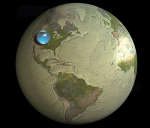 All the Water on Planet Earth
15.05.2012
How much of planet Earth is made of water? Very little, actually. Although oceans of water cover about 70 percent of Earth's surface, these oceans are shallow compared to the Earth's radius.
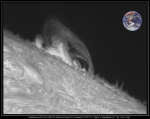 Sun and Prominence
4.03.2014
Dramatic prominences can sometimes be seen looming just beyond the edge of the sun. Such was the case last week as a large prominence, visible above, highlighted a highly active recent Sun. A waving...
|
January February March April May June July August September October November |
||||||||||||||||||||||||||||||||||||||||||||||||||||||||