
|
You entered: night sky
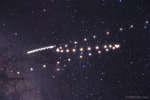 Retrograde Mars and Saturn
15.09.2016
Wandering Mars and Saturn have spent much of this year remarkably close in planet Earth's night sky. In a sequence of exposures spanning mid-December 2015 through the beginning of this week, this composited...
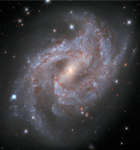 Supernova in NGC 2525
23.10.2020
Big, beautiful, barred spiral galaxy NGC 2525 lies 70 million light-years from the Milky Way. It shines in Earth's night sky within the boundaries of the southern constellation Puppis. About 60,000 light-years...
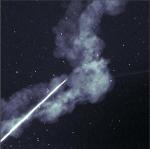 Leonid Glowworm
28.04.2000
Recent Leonid meteor showers have been rich in bright fireball meteors which leave lingering trails stretching across the night sky. These trails, or persistent trains, are mysteriously self-luminescent and do not shine by reflected light.
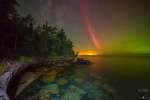 A Proton Arc Over Lake Superior
3.08.2015
The setting had been picked out -- all that was needed was an aurora. And late last August, forecasts predicted that an otherwise beautiful night sky would be lit up with auroral green. Jumping into...
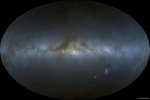 All Sky Milky Way Panorama
25.11.2009
If you could go far away from the Earth and look around the entire sky -- what would you see? Such was the goal of the All-Sky Milky Way Panorama 2.0 project of Axel Mellinger.
 APOD: 2024 August 13 Б Giant Jet from the International Space Station
13.08.2024
What's that on the horizon? When circling the Earth on the International Space Station early last month, astronaut Matthew Dominick saw an unusual type of lightning just beyond the Earth's edge: a gigantic jet. The powerful jet appears on the left of the featured image in red and blue.
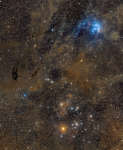 Pleiades to Hyades
6.12.2019
This cosmic vista stretches almost 20 degrees from top to bottom, across the dusty constellation Taurus. It begins at the Pleiades and ends at the Hyades, two star clusters recognized since antiquity in Earth's night sky. At top, the compact Pleiades star cluster is about 400 light-years away.
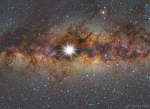 Solstice Sun and Milky Way
21.12.2021
Welcome to December's solstice, first day of winter in the north and summer for the southern hemisphere. Astronomical markers of the seasons, solstice and equinox dates are based on the Sun's place in its annual journey along the ecliptic, through planet Earth's sky.
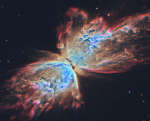 The Butterfly Nebula from Hubble
1.10.2014
The bright clusters and nebulae of planet Earth's night sky are often named for flowers or insects. Though its wingspan covers over 3 light-years, NGC 6302 is no exception. With an estimated surface...
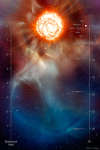 Betelgeuse Imagined
1.01.2020
Why is Betelgeuse fading? No one knows. Betelgeuse, one of the brightest and most recognized stars in the night sky, is only half as bright as it used to be only five months ago.
|
January February March April May |
|||||||||||||||||||||||||||||||||||||||||||||||||