
|
You entered: launch
 Parker vs Perseid
16.08.2018
The brief flash of a bright Perseid meteor streaks across the upper right in this composited series of exposures made early Sunday morning near the peak of the annual Perseid meteor shower.
 The X-Ray Sky
2.01.1996
What if you could see X-rays? If you could, the night sky would be a strange and unfamiliar place. X-rays are about 1,000 times more energetic than visible light photons and are produced in violent and high temperature astrophysical environments.
 Farther Along
6.05.2011
What is humanity's most distant spacecraft? Launched in 1977, Voyager 1 now holds that distinction at 17.5 billion kilometers from the Sun. That corresponds to 16 light-hours or 117 Astronomical Units (AU). This...
 Juno Mission Trailer
28.06.2016
What will NASA's Juno spacecraft find when it reaches Jupiter next Monday? Very little, if Juno does not survive Jupiter Orbit Insertion, a complex series of operations in an unknown environment just above Jupiter's cloud tops.
 Planck Maps the Microwave Background
22.07.2018
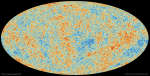
What is our universe made of? To help find out, ESA launched the Planck satellite from 2009 to 2013 to map, in unprecedented detail, slight temperature differences on the oldest optical surface known -- the background sky when our universe first became transparent to light.
 Microwave Hotspots: The Oldest Structures Known
29.10.2000
These spots are the oldest, most distant structures known. They are seen on the above two images of the microwave sky, north and south of our galaxy's equator, based on four-year's worth of data from NASA's COsmic Background Explorer (COBE) satellite (1989-1993). The spots represent temperature variations in the early universe.
 A Mysterious Streak Above Hawaii
8.02.2005
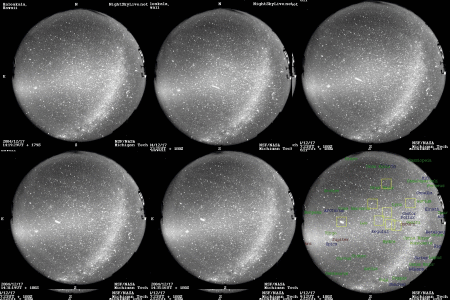
What in heavens-above was that? Not everything seen on the night sky is understood. The Night Sky Live (NSL) project keeps its global array of continuously updating web cameras (CONCAMs) always watching the night sky.
 Jupiters Clouds from New Horizons
26.06.2016
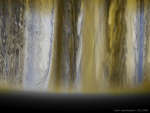
The New Horizons spacecraft took some stunning images of Jupiter on its way out to Pluto. Famous for its Great Red Spot, Jupiter is also known for its regular, equatorial cloud bands, visible through even modest sized telescopes.
 Chandra X Ray Telescope
27.07.1999
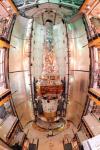
Wrapped in protective blankets and mounted atop an Inertial Upper Stage (IUS) rocket, the Chandra X-ray Telescope is seen in this wide-angle view before launch snuggled into the space shuttle Columbia's payload bay.
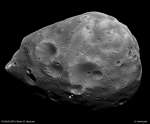 Phobos from Mars Express
17.03.2010
Why is this small object orbiting Mars? The origin of Phobos, the larger of the two moons orbiting Mars, remains unknown. Phobos and Deimos appear very similar to C-type asteroids, yet gravitationally capturing such asteroids, circularizing their orbits, and dragging them into Mars' equatorial plane seems unlikely.
|
January February March April May June July August September |
|||||||||||||||||||||||||||||||||||||||||||||||||