
|
You entered: explosion
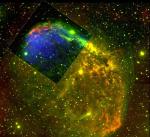 NGC 6888: X Rays in the Wind
16.10.2003
NGC 6888, also known as the Crescent Nebula, is a cosmic bubble of interstellar gas about 25 light-years across. Created by winds from the bright, massive star seen near the center of this composite image, the shocked filaments of gas glowing at optical wavelengths are represented in green and yellowish hues.
 The Lonely Neutron Star in Supernova E0102 72.3
30.09.2018
Why is this neutron star off-center? Recently a lone neutron star has been found within the debris left over from an old supernova explosion. The "lonely neutron star" in question is the blue dot at the center of the red nebula near the bottom left of E0102-72
 APOD: 2024 March 25 Б Sonified: The Jellyfish Nebula Supernova Remnant
25.03.2024
What does a supernova remnant sound like? Although sound is a compression wave in matter and does not carry into empty space, interpretive sound can help listeners appreciate and understand a visual image of a supernova remnant in a new way. Recently, the Jellyfish Nebula (IC 443) has been sonified quite creatively.
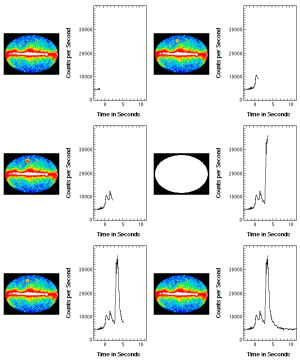 Gamma Ray Bursting
4.11.1999
Using graphics and data from NASA's Compton Gamma Ray Observatory, this animation illustrates one of the most exciting mysteries of modern astrophysics, gamma-ray bursts. Incredibly gamma-ray bursts, sudden flashes of radiation with over 100,000 times the energy of visible light photons, occur several times a day.
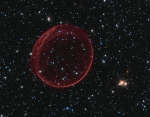 The Rippled Red Ribbons of SNR 0509
25.01.2011
What is causing the picturesque ripples of supernova remnant SNR 0509-67
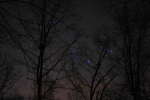 The Fainting of Betelgeuse
2.01.2020
Begirt with many a blazing star, Orion the Hunter is one of the most recognizable constellations. In this night skyscape the Hunter's stars rise in the northern hemisphere's winter sky on December 30, 2019, tangled in bare trees near Newnan, Georgia, USA.
 Supernova Remnant N132D in Optical and X Rays
25.10.2005
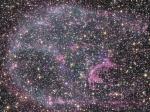
Thousands of years after a star exploded, its expanding remnant still glows brightly across the spectrum. Such is the case with N132D, a supernova remnant located in the neighboring Large Magellanic Cloud (LMC) galaxy. The expanding shell from this explosion now spans 80 light-years and has swept up about 600 Suns worth of mass.
 NGC 6188 and NGC 6164
28.12.2012
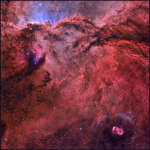
Fantastic shapes lurk in clouds of glowing hydrogen gas in NGC 6188, about 4,000 light-years away. The emission nebula is found near the edge of a large molecular cloud unseen at visible wavelengths, in the southern constellation Ara.
 The Case of the Missing Supernova Companion
12.01.2012
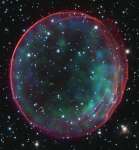
Where's the other star? At the center of this supernova remnant should be the companion star to the star that blew up. Identifying this star is important for understanding just how Type...
 APOD: 2023 September 4 Б Cygnus: Bubble and Crescent
4.09.2023
As stars die, they create clouds. Two stellar death clouds of gas and dust can be found toward the high-flying constellation of the Swan (Cygnus) as they drift through rich star fields in the plane of our Milky Way Galaxy.
|
January February March April May June July August September October |
|||||||||||||||||||||||||||||||||||||||||||||||||