
|
You entered: star formation
 APOD: 2025 April 14 Б The Galactic Center in Radio from MeerKAT
14.04.2025
What's happening at the center of our galaxy? It's hard to tell with optical telescopes since visible light is blocked by intervening interstellar dust. In other bands of light, though, such as radio, the galactic center can be imaged and shows itself to be quite an interesting and active place.
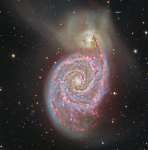 Hydrogen in M51
11.06.2010
Perhaps the original spiral nebula, M51 is a large galaxy, over 60,000 light-years across, with a readily apparent spiral structure. Also cataloged as NGC 5194, M51 is a part of a well-known interacting galaxy pair, its spiral arms and dust lanes clearly sweeping in front of companion galaxy NGC 5195 (top).
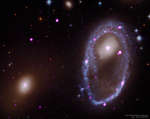 Cosmic Collision Forges Galactic Ring
17.09.2018
How could a galaxy become shaped like a ring? The rim of the blue galaxy pictured on the right is an immense ring-like structure 150,000 light years in diameter composed of newly formed, extremely bright, massive stars.
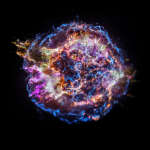 Recycling Cassiopeia A
28.12.2017
Massive stars in our Milky Way Galaxy live spectacular lives. Collapsing from vast cosmic clouds, their nuclear furnaces ignite and create heavy elements in their cores. After a few million years, the enriched material is blasted back into interstellar space where star formation can begin anew.
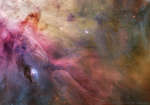 LL Ori and the Orion Nebula
18.02.2018
Stars can make waves in the Orion Nebula's sea of gas and dust. This esthetic close-up of cosmic clouds and stellar winds features LL Orionis, interacting with the Orion Nebula flow. Adrift...
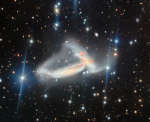 APOD: 2026 September 4 Б Na Uhane Mahoe Huki Pu i ke Ola
4.09.2026
Nд йUhane Mдhoe Huki Pе i ke Ola, is the Hawaiian name given to this image of a pair of spiral galaxies locked in a mutual gravitational embrace. Some 200 million light-years distant toward...
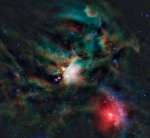 Young Stars in the Rho Ophiuchi Cloud
14.04.2011
Dust clouds and embedded newborn stars glow at infrared wavelengths in this tantalizing false-color composition from WISE, the Wide-field Infrared Survey Explorer. The cosmic canvas features one of the closest star forming regions, part of the Rho Ophiuchi cloud complex some 400 light-years distant near the southern edge of the pronounceable constellation Ophiuchus.
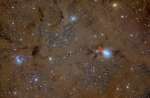 Stardust in Perseus
4.02.2010
This cosmic expanse of dust, gas, and stars covers close to 3 degrees on the sky in the heroic constellation Perseus. Right of center in the gorgeous skyscape is the dusty blue reflection nebula NGC 1333, about 1,000 light-years away. At that estimated distance, the field of view is about 50 light-years across.
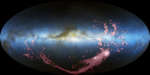 The Magellanic Stream
25.01.2010
Spanning the sky toward the majestic Clouds of Magellan is an unusual stream of gas: the Magellanic Stream. The origin of this gas remains unknown but likely hold a clue to origin and fate of our Milky Way's most famous satellite galaxies: the LMC and the SMC.
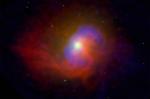 NGC 4696: Energy from a Black Hole
27.04.2006
In many cosmic environments, when material falls toward a black hole energy is produced as some of the matter is blasted back out in jets. In fact, such black hole "engines" appear to be the most efficient in the Universe, at least on a galactic scale.
|
January February March April May June July August September October |
|||||||||||||||||||||||||||||||||||||||||||||||||