
|
You entered: massive stars
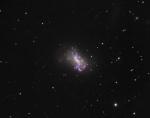 Small Galaxy NGC 4449
3.05.2007
Grand spiral galaxies often seem to get all the glory. Their newly formed, bright, blue star clusters along beautiful, symmetric spiral arms are guaranteed to attract attention. But small irregular galaxies form stars too, like NGC 4449, located about 12 million light-years away.
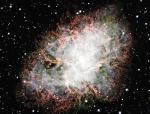 The Crab Nebula from CFHT
28.01.2004
This is the mess that is left when a star explodes. The Crab Nebula, the result of a supernova seen in 1054 AD, is filled with mysterious filaments. The filaments are not only tremendously...
 Elements of the Swan Nebula
11.08.2003
In the depths of the dark clouds of dust and molecular gas known as M17, stars continue to form. Also known as the Omega Nebula and Horseshoe Nebula, the darkness of M17's molecular clouds results from background starlight being absorbed by thick filaments of carbon-based smoke-sized dust.
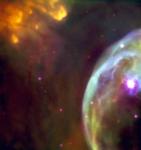 Close Up of the Bubble Nebula
18.11.1998
It's the bubble versus the cloud. NGC 7635, the Bubble Nebula, is being pushed out by the stellar wind of massive central star BD+602522. Next door, though, lives a giant molecular cloud, visible above to the upper left.
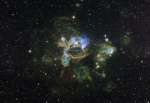 The N44 Complex
27.03.2008
A truly giant complex of emission nebulae, N44 is about 1,000 light-years across. It shines in southern skies as a denizen of our neighboring galaxy, the Large Magellanic Cloud, 170,000 light-years away.
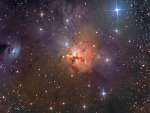 NGC 1579: Trifid of the North
30.01.2009
Colorful NGC 1579 resembles the better known Trifid Nebula, but lies much farther north in planet Earth's sky, in the heroic constellation Perseus. About 2,100 light-years away and 3 light-years across...
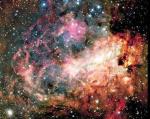 M17: Omega Nebula Star Factory
10.12.2002
In the depths of the dark clouds of dust and molecular gas known as M17, stars continue to form. The similarity to the Greek letter capital Omega gives the molecular cloud its popular name, but the nebula is also known as the Swan Nebula, the Horseshoe Nebula, and M17.
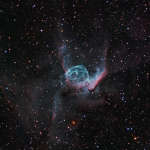 Thor s Helmet
7.03.2013
This helmet-shaped cosmic cloud with wing-like appendages is popularly called Thor's Helmet. Heroically sized even for a Norse god, Thor's Helmet is about 30 light-years across. In fact, the helmet is actually...
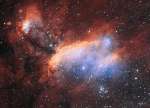 IC 4628: The Prawn Nebula
23.09.2013
South of Antares, in the tail of the nebula-rich constellation Scorpius, lies emission nebula IC 4628. Nearby hot, massive stars, millions of years young, radiate the nebula with invisible ultraviolet light, stripping electrons from atoms. The electrons eventually recombine with the atoms to produce the visible nebular glow, dominated by the red emission of hydrogen.
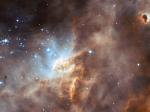 N11B: Star Cloud of the LMC
7.07.2004
Massive stars, abrasive winds, mountains of dust, and energetic light sculpt one of the largest and most picturesque regions of star formation in the Local Group of Galaxies. Known as N11, the region...
|
January February |
|||||||||||||||||||||||||||||||||||||||||||||||||