
|
You entered: hot star
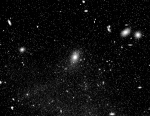 The Virgo Cluster of Galaxies
20.02.2000
Pictured are several galaxies of the Virgo Cluster, the closest cluster of galaxies to our Milky Way Galaxy. The Virgo Cluster spans more than 5 degrees on the sky - about 10 times the angle made by a full Moon. It contains over 100 galaxies of many types - including spirals, ellipticals, and irregular galaxies.
 Sharpless 308: The Dolphin Head Nebula
7.06.2024
Blown by fast winds from a hot, massive star, this cosmic bubble is huge. Cataloged as Sharpless 2-308 it lies some 5,000 light-years away toward the well-trained constellation Canis Major and covers slightly more of the sky than a Full Moon. That corresponds to a diameter of 60 light-years at its estimated distance.
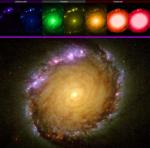 NGC 1512: A Panchromatic View
6.06.2001
This spectacular color picture of the core of barred spiral galaxy NGC 1512 (bottom panel) is a composite of the seven Hubble Space Telescope images arrayed along the top. Each top panel image was made with a filter and camera sensitive to a different wavelength band in the electromagnetic spectrum.
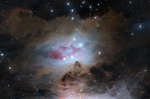 Reflections on the 1970s
2.02.2023
The 1970s are sometimes ignored by astronomers, like this beautiful grouping of reflection nebulae in Orion - NGC 1977, NGC 1975, and NGC 1973 - usually overlooked in favor of the substantial glow from the nearby stellar nursery better known as the Orion Nebula.
 NGC 2403 in Camelopardalis
3.06.2024
Magnificent island universe NGC 2403 stands within the boundaries of the long-necked constellation Camelopardalis. Some 10 million light-years distant and about 50,000 light-years across, the spiral galaxy also seems to have more than its fair share of giant star forming HII regions, marked by the telltale reddish glow of atomic hydrogen gas.
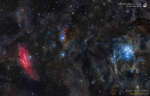 From California to the Pleiades
22.11.2013
An astronomical trip from the California Nebula to the Pleiades star cluster would cover just 12 degrees across planet Earth's night sky. That's equivalent to the angular extent of 25 Full Moons, as your telescope sweeps over the borders of the constellations Perseus and Taurus.
 Gamma Cas and Friends
24.12.2009
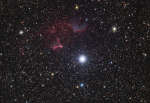
Gamma Cassiopeiae shines high in northern autumn evening skies. The brightest spiky star in this rich and colorful Milky Way starfield, bluish Gamma Cas marks the central peak in the W-shaped constellation Cassiopeia.
 The Comet, the Owl, and the Galaxy
24.03.2017
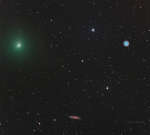
Comet 41P/Tuttle-Giacobini-Kresak poses for a Messier moment in this telescopic snapshot from March 21. In fact it shares the 1 degree wide field-of-view with two well-known entries in the 18th century comet-hunting astronomer's famous catalog.
 NGC 7822: Cosmic Question Mark
13.10.2021
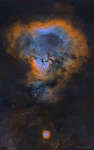
It may look like a huge cosmic question mark, but the big question really is how does the bright gas and dark dust tell this nebula's history of star formation. At the edge...
 X-Ray Pleiades
18.03.1997
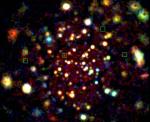
The Pleiades star cluster is one of the jewels of the northern sky. To the unaided eye it appears as a lovely and tantalizing grouping of stars in the constellation of Taurus, while telescopic views reveal cluster stars surrounded by delicate blue wisps of dust-reflected starlight.
|
January February |
|||||||||||||||||||||||||||||||||||||||||||||||||