
|
You entered: light
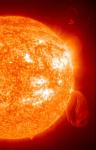 Maximum Sun
1.03.2001
Astronomers recently witnessed an astounding, large scale solar event as the Sun's north and south magnetic poles changed places! But, this complete solar magnetic field flip was actually anticipated. It occurs every 11 years during the maximum of the solar activity cycle.
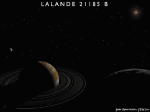 Lalande 21185: The Nearest Planetary System?
19.10.1996
What's the closest extrasolar planetary system? It may well be planets of the dim red dwarf star cataloged as Lalande 21185 -- a mere 8 light years distant. This star is too faint to be seen by the naked eye and its planets have not been imaged directly.
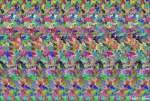 The Holographic Principle
23.04.2017
Is this picture worth a thousand words? According to the Holographic Principle, the most information you can get from this image is about 3 x 10 65 bits for a normal sized computer monitor.
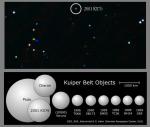 How Big Is 2001 KX76
30.08.2001
Newly discovered minor planet 2001 KX76 is circled in the top panel above, a recent composite image from the European Southern Observatory's 2.2 meter telescope at La Silla, Chile. Though 2001 KX76 appears...
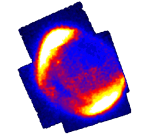 SN 1006: Pieces of the Cosmic Ray Puzzle
16.10.1996
Research balloon flights conducted in 1912 by Austrian physicist Victor Hess revealed that the Earth was constantly bombarded by high energy radiation from space - which came to be called "Cosmic Rays". What are Cosmic Rays and where do they come from?
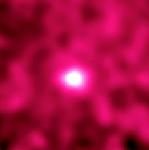 The Gamma Ray Moon
10.02.1997
What if you could see gamma rays (photons with more than 40 million times the energy of visible light)? If you could, the Moon would appear brighter than the Sun! This startling notion...
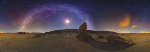 The Milky Way Over Tenerife
5.04.2011
Have you ever seen the band of our Milky Way Galaxy? Chances are you have never seen it like this -- nor could you. In a clear sky from a dark location at the right time, a faint band of light is visible across the sky. This band is the disk of our spiral galaxy.
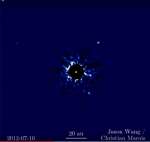 Four Planets Orbiting Star HR 8799
1.02.2017
Does life exist outside our Solar System? To help find out, NASA has created the Nexus for Exoplanet System Science (NExSS) to better locate and study distant star systems that hold hope of harboring living inhabitants.
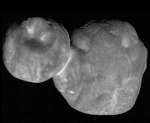 Sharpest Ultima Thule
28.02.2019
On January 1, New Horizons swooped to within 3,500 kilometers of the Kuiper Belt world known as Ultima Thule. That's about 3 times closer than its July 2015 closest approach to Pluto.
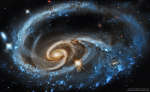 UGC 1810: Wildly Interacting Galaxy from Hubble
18.10.2020
What's happening to this spiral galaxy? Although details remain uncertain, it surely has to do with an ongoing battle with its smaller galactic neighbor. The featured galaxy is labelled UGC 1810 by itself, but together with its collisional partner is known as Arp 273.
|
January February |
|||||||||||||||||||||||||||||||||||||||||||||||||