
|
You entered: telescope
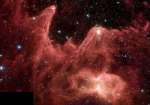 Mountains of Creation
15.12.2007
(xxxedit and linkxxx) This fantastic skyscape lies at the eastern edge of giant stellar nursery W5, about 7,000 light-years away in the constellation Cassiopeia. An infrared view from the Spitzer Space Telescope...
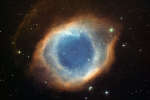 The Helix Nebula from La Silla Observatory
3.03.2009
Will our Sun look like this one day? The Helix Nebula is one of brightest and closest examples of a planetary nebula, a gas cloud created at the end of the life of a Sun-like star.
 A Message From Earth
13.03.2005
What are these Earthlings trying to tell us? The above message was broadcast from Earth towards the globular star cluster M13 in 1974. During the dedication of the Arecibo Observatory - still the largest radio telescope in the world - a string of 1's and 0's representing the above diagram was sent.
 A Message From Earth
19.02.2012
What are these Earthlings trying to tell us? The above message was broadcast from Earth towards the globular star cluster M13 in 1974. During the dedication of the Arecibo Observatory - still the largest single radio telescope in the world - a string of 1's and 0's representing the above diagram was sent.
 APOD: 2025 April 20 Б The Orion Nebula in Visible and Infrared
20.04.2025
The Great Nebula in Orion is a colorful place. Visible to the unaided eye, it appears as a small fuzzy patch in the constellation of Orion. Long exposure, multi-wavelength images like this, however, show the Orion Nebula to be a busy neighborhood of young stars, hot gas, and dark dust.
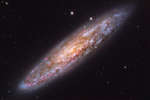 NGC 253: Dusty Island Universe
6.11.2025
Shiny NGC 253 is one of the brightest spiral galaxies visible, and also one of the dustiest. Some call it the Silver Coin Galaxy for its appearance in small telescopes, or just the Sculptor Galaxy for its location within the boundaries of the southern constellation Sculptor.
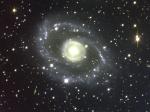 Spiral Galaxy In Centaurus
19.04.2003
Centaurus, the Centaur, is one of the most striking constellations in the southern sky. The lovely Milky Way flows through this large constellation whose celestial wonders also include the closest star to the sun, Alpha Centauri, the largest globular star cluster in our galaxy, Omega Centauri, and the closest active galaxy, Centaurus A.
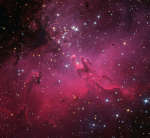 M16 and the Eagle Nebula
15.11.2019
A star cluster around 2 million years young surrounded by natal clouds of dust and glowing gas, M16 is also known as The Eagle Nebula. This beautifully detailed portrait of the region was made with groundbased narrow and broadband image data.
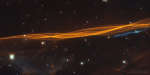 Filaments of the Cygnus Loop
28.09.2020
What lies at the edge of an expanding supernova? Subtle and delicate in appearance, these ribbons of shocked interstellar gas are part of a blast wave at the expanding edge of a violent stellar explosion that would have been easily visible to humans during the late stone age, about 20,000 years ago.
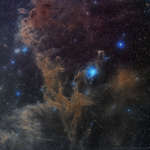 Chamaeleon Dark Nebulas
17.01.2022
Sometimes the dark dust of interstellar space has an angular elegance. Such is the case toward the far-south constellation of Chamaeleon. Normally too faint to see, dark dust is best known for blocking visible light from stars and galaxies behind it.
|
January February March April May |
|||||||||||||||||||||||||||||||||||||||||||||||||