
|
You entered: star system
 Andromeda in a Single Shot
25.06.2021
How far can you see? The Andromeda Galaxy, 2.5 million light years away, is the most distant object easily seen by the unaided eye. Other denizens of the night sky, like stars, clusters, and nebulae, are typically hundreds to thousands of light-years distant.
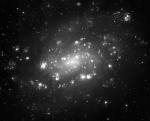 Shell Game in NGC 300
22.08.2002
Featured in color in yesterday's episode, big, beautiful, face-on spiral galaxy NGC 300 is seen here through a narrow filter that transmits only the red light of hydrogen atoms. Ionized by energetic starlight, a hydrogen atom emits the characteristic red H-alpha light as its single electron is recaptured and transitions to lower energy states.
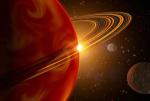 Saturn-Sized Worlds Discovered
30.03.2000
The last decade saw the profound discovery of many worlds beyond our solar system, but none analogs of our home planet Earth. Exploiting precise observational techniques, astronomers inferred the presence of well over two dozen extrasolar planets, most nearly as massive as gas giant Jupiter or more, in close orbits around sun-like stars.
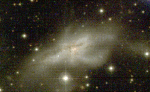 NGC 6240: When Galaxies Collide
28.12.1995
Sometimes even galaxies can suffer a fatal attraction. Here gravity causes two galaxies to collide in a spectacular display of energetic gas, dust, and light. When galaxies collide it is rare that any stars in the galaxies themselves collide, or that any change will be seen in a human lifetime.
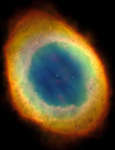 M57: The Ring Nebula
15.11.2009
It looks like a ring on the sky. Hundreds of years ago astronomers noticed a nebula with a most unusual shape. Now known as M57 or NGC 6720, the gas cloud became popularly known as the Ring Nebula.
 Orion and the Running Man
13.11.2025
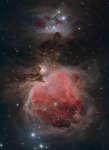
Few cosmic vistas can excite the imagination like The Great Nebula in Orion. Visible as a faint, bland celestial smudge to the naked-eye, the nearest large star-forming region sprawls across this sharp colorful telescopic image. Designated M42 in the Messier Catalog, the Orion Nebula's glowing gas and dust surrounds hot, young stars.
 Orion and the Running Man
10.03.2023
Few cosmic vistas excite the imagination like The Great Nebula in Orion. Visible as a faint celestial smudge to the naked-eye, the nearest large star-forming region sprawls across this sharp telescopic image, recorded on a cold January night in dark skies from West Virginia, planet Earth.
 APOD: 2025 August 9 Б Interstellar Interloper 3I/ATLAS from Hubble
9.08.2025
Discovered on July 1 with the NASA-funded ATLAS (Asteroid Terrestrial-impact Last Alert System) survey telescope in Rio Hurtado, Chile, 3I/ATLAS is so designated as the third known interstellar object to pass through our Solar System. It follows 1I/йOumuamua in 2017 and the comet 2I/Borisov in 2019.
 Cometary Globule CG4
5.03.2015
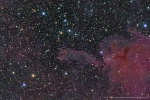
The faint and somehow menacing cometary globule CG4 reaches through the center of this deep southern skyscape. About 1,300 light-years from Earth toward the constellation Puppis, its head is about 1.5 light-years in diameter and its tail about 8 light-years long.
 APOD: 2025 September 26 Б A SWAN an ATLAS and Mars
26.09.2025
A new visitor to the inner Solar System, comet C/2025 R2 (SWAN) sports a long ion tail extending diagonally across this almost 7 degree wide telescopic field of view recorded on September 21.
|
January February March April May June |
|||||||||||||||||||||||||||||||||||||||||||||||||