
|
You entered: star cluster
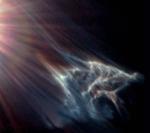 Reflecting Merope
3.12.2004
In the well known Pleiades star cluster, a star's light is slowly destroying this wandering cloud of gas and dust. Above, the star Merope lies just off the upper left edge of this picture from the Hubble Space Telescope.
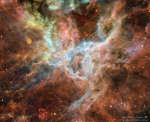 In the Heart of the Tarantula Nebula
19.05.2018
In the heart of monstrous Tarantula Nebula lies huge bubbles of energetic gas, long filaments of dark dust, and unusually massive stars. In the center of this heart, is a knot of stars so dense that it was once thought to be a single star.
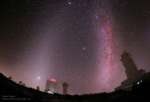 Zodiacal Light Vs Milky Way
11.02.2009
Two fundamental planes of planet Earth's sky compete for attention in this remarkable wide-angle vista, recorded on January 23rd. Arcing above the horizon and into the night at the left is a beautiful band of Zodiacal Light - sunlight scattered by dust in the solar system's ecliptic plane.
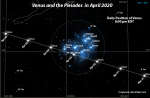 Venus and the Pleiades in April
1.04.2020
Venus is currently the brilliant evening star. Shared around world, in tonight's sky Venus will begin to wander across the face of the lovely Pleiades star cluster. This digital sky map illustrates the path of the inner planet as the beautiful conjunction evolves, showing its position on the sky over the next few days.
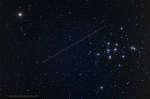 Close Encounter with M44
28.01.2015
On Monday, January 26, well-tracked asteroid 2004 BL86 made its closest approach, a mere 1.2 million kilometers from our fair planet. That's about 3.1 times the Earth-Moon distance or 4 light-seconds away. Moving...
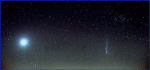 Comet Hyakutake on a Starry Night
23.04.1996
It was a starry night in April (April 9th, 1996, 9:32 pm CDT to be exact) near Lone Jack, Missouri when Comet Hyakutake graced this astronomically rich field. Making an appearance as the brilliant evening star, Venus is overexposed at the far left.
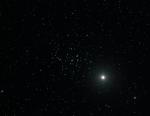 Saturn in the Hive
27.01.2006
If you can find Saturn in tonight's sky, then you can also find M44, popularly known as the Beehive star cluster. In fact, with a pair of binoculars most casual skygazers should find it fairly easy to zero in on this celestial scene.
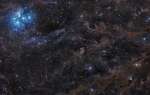 Sisters of the Dusty Sky
17.11.2010
Hurtling through a cosmic dust cloud some 400 light-years away, the lovely Pleiades or Seven Sisters star cluster is well-known for its striking blue reflection nebulae. In the dusty sky toward the constellation Taurus and the Orion Arm of our Milky Way Galaxy, this remarkable image shows the famous star cluster at the upper left.
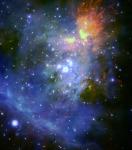 The Orion Nebula from Subaru
1.02.1999
The Orion Nebula (M42) shows a host of treasures when viewed in infrared light. Some stars in the Trapezium, an open cluster of stars at the center, are only visible in infrared light. The orange feature above center is called the Kleinman-Low Nebula, and appears greatly affected by newly forming central star IRc2.
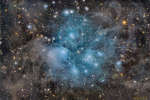 The Pleiades Deep and Dusty
25.02.2014
The well known Pleiades star cluster is slowly destroying part of a passing cloud of gas and dust. The Pleiades is the brightest open cluster of stars on Earth's sky and can be seen from almost any northerly location with the unaided eye.
|
January February March April May |
|||||||||||||||||||||||||||||||||||||||||||||||||