
|
You entered: night sky
 APOD: 2024 October 2 Б The Large Magellanic Cloud Galaxy
1.10.2024
It is the largest satellite galaxy of our home Milky Way Galaxy. If you live in the south, the Large Magellanic Cloud (LMC) is quite noticeable, spanning about 10 degrees across the night sky, which is 20 times larger than the full moon towards the southern constellation of the dolphinfish (Dorado).
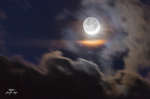 APOD: 2026 April 24 Б Young Moon and Sister Stars
23.04.2026
Sunlit arms of a crescent moon seem to embrace the faint lunar night side in this dramatic celestial scene from planet Earth. The single telephoto exposure tracking the sky was captured on the night of April 19, when a two day old Moon was near perigee in its elliptical orbit.
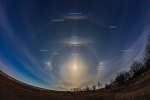 Ice Halos by Moonlight
13.05.2022
An almost full moon on April 15 brought these luminous apparitions to a northern spring night over Alberta Canada. On that night, bright moonlight refracted and reflected by hexagonal ice crystals in high clouds created a complex of halos and arcs more commonly seen by sunlight in daytime skies.
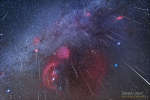 Geminids and Friends
14.12.2018
From a radiant in the constellation of the Twins, the annual Geminid meteor shower rained down on our fair planet this week. This beautiful skyscape collects about 70 of Gemini's lovely shooting stars in a digital composition made from multiple exposures.
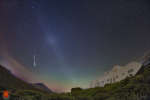 A Meteor and the Gegenschein
11.05.2021
Is the night sky darkest in the direction opposite the Sun? No. In fact, a rarely discernable faint glow known as the gegenschein (German for "counter glow") can be seen 180 degrees around from the Sun in an extremely dark sky. The gegenschein is sunlight back-scattered off small interplanetary dust particles.
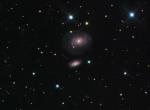 NGC 1 and NGC 2
19.08.2005
Beautiful nebulae, clusters, and galaxies that grace planet Earth's night sky are often known by their New General Catalog designation or NGC number. That classic listing was compiled by John Louis Emil Dreyer, remarkable director of the Armagh Observatory from 1882 to 1916.
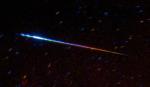 A Perseid Meteor
12.08.2000
This weekend, the annual Perseid Meteor Shower reaches its maximum. Grains of cosmic sand and gravel shed from Comet Swift-Tuttle will streak across the sky as they vaporize during entry into Earth's atmosphere. The Perseids result from the yearly
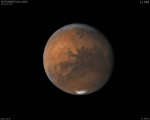 Solis Lacus: The Eye of Mars
30.09.2020
As telescopes around planet Earth watch, Mars is growing brighter in night skies, approaching its 2020 opposition on October 13. Mars looks like its watching too in this view of the Red Planet from September 22.
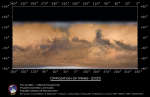 Global Map: Mars at Opposition
19.11.2020
This may be the best global Mars map made with a telescope based on planet Earth. The image data were captured by a team of observers over six long nights...
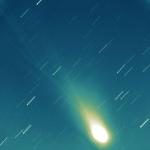 Tails Of Comet LINEAR
27.07.2000
Comet C/1999 S4 LINEAR is only one of many comets discovered with the Lincoln Near Earth Asteroid Research (LINEAR) telescope operating near Soccoro, New Mexico, USA. Traveling steadily southward through Earth's night...
|
January February March April May |
|||||||||||||||||||||||||||||||||||||||||||||||||