
|
You entered: hot star
 Reflections on the 1970s
20.12.2007
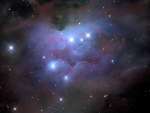
The 1970s are sometimes ignored by astronomers. In particular, this beautiful grouping of reflection nebulae in Orion - NGC 1977, NGC 1975, and NGC 1973 - are usually overlooked in favor of the substantial glow from the nearby stellar nursery better known as the Orion Nebula.
 APOD: 2023 May 30 Б M27: The Dumbbell Nebula
30.05.2023
Is this what will become of our Sun? Quite possibly. The first hint of our Sun's future was discovered inadvertently in 1764. At that time, Charles Messier was compiling a list of diffuse objects not to be confused with comets.
 The Lagoon Nebula from GigaGalaxy Zoom
6.10.2009
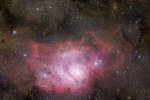
The large majestic Lagoon Nebula is home for many young stars and hot gas. Spanning 100 light years across while lying only about 5000 light years distant, the Lagoon Nebulae is so big and bright that it can be seen without a telescope toward the constellation of Sagittarius.
 IC 1805: Light from the Heart
17.09.2004
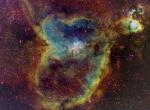
Sprawling across hundreds of light-years, emission nebula IC 1805 is a mix of glowing interstellar gas and dark dust clouds. Only about 7,500 light-years away, stars were born in this region whose nickname - the Heart Nebula - derives from its suggestive shape (seen here sideways).
 A Giant Squid in the Flying Bat
27.10.2016
Very faint but also very large on planet Earth's sky, a giant Squid Nebula cataloged as Ou4, and Sh2-129 also known as the Flying Bat Nebula, are both caught in this cosmic scene toward the royal constellation Cepheus.
 APOD: 2024 May 24 Б M78 from the Euclid Space Telescope
24.05.2024
Star formation can be messy. To help find out just how messy, ESA's new Sun-orbiting Euclid telescope recently captured the most detailed image ever of the bright star forming region M78. Near...
 J102815: A Star That Should Not Exist
7.09.2011
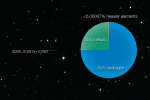
Why does this star have so few heavy elements? Stars born in the generation of our Sun have an expected abundance of elements heavier than hydrogen and helium mixed into their atmospheres. Stars born...
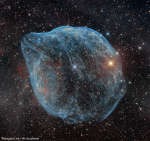 Sharpless 308: The Dolphin-Head Nebula
21.10.2021
Blown by fast winds from a hot, massive star, this cosmic bubble is huge. Cataloged as Sharpless 2-308 it lies some 5,000 light-years away toward the constellation of the Big Dog (Canis Major) and covers slightly more of the sky than a Full Moon.
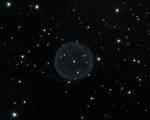 Spherical Planetary Nebula Abell 39
28.07.2005
Ghostly in appearance, Abell 39 is a remarkably simple, spherical nebula about five light-years across. Well within our own Milky Way galaxy, the cosmic sphere is roughly 7,000 light-years distant toward the constellation Hercules.
 APOD: 2025 June 1 Б UGC 1810: Wildly Interacting Galaxy from Hubble
1.06.2025
What's happening to this spiral galaxy? Although details remain uncertain, it surely has to do with an ongoing battle with its smaller galactic neighbor. The featured galaxy is labelled UGC 1810 by itself, but together with its collisional partner is known as Arp 273.
|
January February |
|||||||||||||||||||||||||||||||||||||||||||||||||