
|
You entered: background
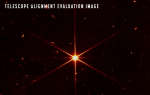 2MASS J17554042 6551277
19.03.2022
2MASS J17554042+6551277 doesn't exactly roll off the tongue but that's the name, a coordinate-based catalog designation, of the star centered in this sharp field of view. Fans of the distant universe should get used to its spiky appearance though.
 APOD: 2025 August 1 Б Small Dark Nebula
1.08.2025
A small, dark, nebula looks isolated near the center of this telescopic close-up. The wedge-shaped cosmic cloudlet lies within a relatively crowded region of space though. About 7,000 light-years distant and filled with glowing gas and an embedded cluster of young stars, the region is known as M16 or the Eagle Nebula.
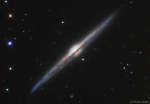 NGC 4565: Galaxy on Edge
24.05.2017
Is our Galaxy this thin? We believe so. Magnificent spiral galaxy NGC 4565 is viewed edge-on from planet Earth. Also known as the Needle Galaxy for its narrow profile, bright NGC 4565 is a stop on many telescopic tours of the northern sky, in the faint but well-groomed constellation Coma Berenices.
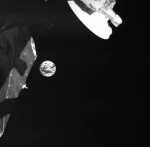 Earth Flyby of BepiColombo
4.05.2020
What it would look like to approach planet Earth? Such an event was recorded visually in great detail by ESA's and JAXA's robotic BepiColombo spacecraft last month as it swung back past Earth on its journey in to the planet Mercury.
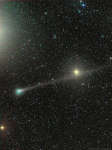 Rosetta s Comet in Gemini
13.11.2021
Returning along its 6.4 year orbit, periodic comet Churyumov-Gerasimenko (67P) is caught in this telescopic frame from November 7. Sweeping past background stars in the constellation Gemini the comet's dusty tail stretches toward the upper right to Upsilon Geminorum.
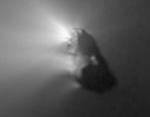 Halley s Nucleus: An Orbiting Iceberg
5.08.2000
What does a comet nucleus look like? Formed from the primordial stuff of the solar system, it is thought to resemble a very dirty iceberg. But for active comets, telescopic images only reveal the surrounding cloud of gas and dust, the comet's coma, and the characteristic cometary tails.
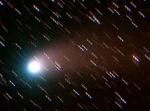 Comet McNaught Hartley
14.03.2001
Outbound and climbing above the plane of our solar system, comet McNaught-Hartley (C/1999 T1) is presently soaring through northern skies. This telescopic picture, a composite of many 30 second exposures made through three color filters, recorded the delicate colors in its diminutive coma and faint tail on February 26th.
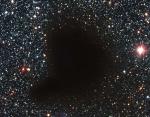 Molecular Cloud Barnard 68
2.02.2003
Where did all the stars go? What used to be considered a hole in the sky is now known to astronomers as a dark molecular cloud. Here, a high concentration of dust and molecular gas absorb practically all the visible light emitted from background stars.
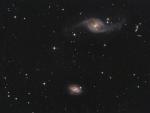 Galaxies in View
7.06.2005
Galaxies abound in this cosmic scene, a well chosen telescopic view toward the northern constellation of Ursa Major. Most noticeable are the striking pair of spiral galaxies - NGC 3718 (above, right) and NGC 3729 (below center) - a mere 52 million light-years distant.
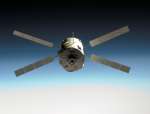 Jules Verne in Orbit
5.04.2008
The bright edge of planet Earth fades into the darkness of space in the background of this view of Jules Verne on an extraordinary voyage. Snapped last Monday, the picture shows the European Space...
|
January February |
|||||||||||||||||||||||||||||||||||||||||||||||||