
|
You entered: Earth's moon
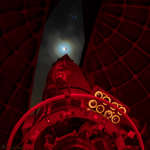 Great Refractor and Lunar Eclipse
26.11.2021
Rain clouds passed and the dome of the Lick Observatory's 36 inch Great Refractor opened on November 19. The historic telescope was pointed toward a partially eclipsed Moon. Illuminated by dim red lighting...
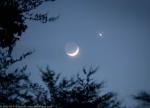 Love and War by Moonlight
24.05.2002
Venus, named for the Roman goddess of love, and Mars, the war god's namesake, approach each other by moonlight in this lovely sky view recorded on May 14th from Dunkirk, Maryland, USA.
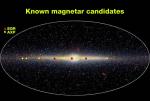 Magnetars In The Sky
26.11.2004
Indicated on this infrared image of the galactic center region are positions of candidate magnetars -- believed to be the strongest magnets in the galaxy. Classified by observers as Soft Gamma Repeaters (SGRs) and Anomalous X-ray Pulsars (AXPs), these cosmic powerhouses are likely city-sized, spinning, highly-magnetized neutron stars. How strong is a magnetar's magnetic field?
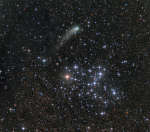 Messier 6 and Comet Siding Spring
17.10.2014
This looks like a near miss but the greenish coma and tail of Comet Siding Spring (C/2013 A1) are really 2,000 light-years or so away from the stars of open cluster Messier 6. They do appear close together though, along the same line-of-sight in this gorgeous October 9th skyscape toward the constellation Scorpius.
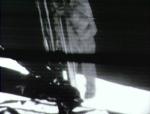 Apollo 11: Onto a New World
19.05.1998
A human first set foot on another world on July 20, 1969. This world was Earth's own Moon. Pictured above is Neil Armstrong preparing to take the historic first step. On the way down the Lunar Module ladder, Armstrong released equipment which included the television camera that recorded this fuzzy image.
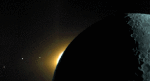 The Ecliptic Plane
21.09.1996
The Plane of the Ecliptic is illustrated in this Clementine star tracker camera image which reveals (from right to left) the Moon lit by Earthshine, the Sun's corona rising over the Moon's dark limb, and the planets Saturn, Mars, and Mercury.
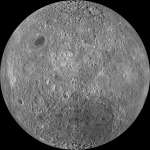 Lunar Farside
5.04.2014
Tidally locked in synchronous rotation, the Moon always presents its familiar nearside to denizens of planet Earth. From lunar orbit, the Moon's farside can become familiar, though. In fact this sharp picture, a mosaic from the Lunar Reconnaissance Orbiter's wide angle camera, is centered on the lunar farside.
 Lunar Farside
30.12.2016
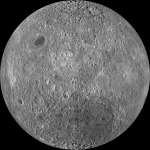
Tidally locked in synchronous rotation, the Moon always presents its familiar nearside to denizens of planet Earth. From lunar orbit, the Moon's farside can become familiar, though. In fact this sharp picture, a mosaic from the Lunar Reconnaissance Orbiter's wide angle camera, is centered on the lunar farside.
 APOD: 2025 April 30 Б A Happy Sky over Bufa Hill in Mexico
30.04.2025
Sometimes, the sky itself seems to smile. A few days ago, visible over much of the world, an unusual superposition of our Moon with the planets Venus and Saturn created just such an iconic facial expression.
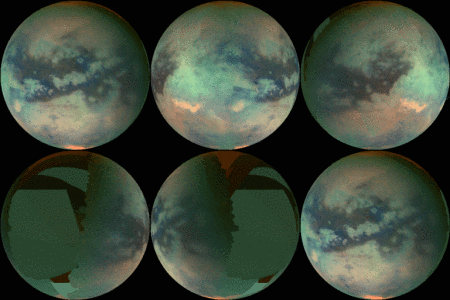 Rotating Titan in Infrared Light
15.02.2006
Titan is one of the strangest places in our Solar System. The only moon known with thick clouds, this unusual satellite of Saturn shows evidence of evaporating lakes created by methane rain. The clouds...
|
January February March April May June July August September |
|||||||||||||||||||||||||||||||||||||||||||||||||