
|
You entered: light
 APOD: 2024 January 29 Б The Pleiades: Seven Dusty Sisters
28.01.2024
The well-known Pleiades star cluster is slowly destroying part of a passing cloud of gas and dust. The Pleiades is the brightest open cluster of stars on Earth's sky and can be seen from almost any northerly location with the unaided eye.
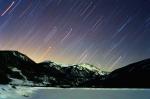 Orion Rising
24.12.2002
Orion always comes up sideways ... and was caught in the act earlier this month by astronomer Jimmy Westlake, stargazing eastward over the Rocky Mountains north of Leadville, Colorado, USA. To make this gorgeous image, Westlake placed his camera on a tripod for two exposures.
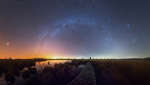 Summer to Winter Milky Way
18.10.2018
Taken near local midnight, this autumn night's panorama follows the arch of the Milky Way across the northern horizon from the High Fens, Eifel Nature Park at the border of Belgium and Germany.
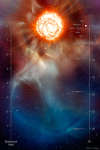 Betelgeuse Imagined
31.12.2019
Why is Betelgeuse fading? No one knows. Betelgeuse, one of the brightest and most recognized stars in the night sky, is only half as bright as it used to be only five months ago.
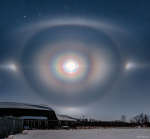 Moon Corona, Halo, and Arcs over Manitoba
23.02.2020
Yes, but could you get to work on time if the Moon looked like this? As the photographer was preparing to drive to work, refraction, reflection, and even diffraction of moonlight from millions of falling ice crystals turned the familiar icon of our Moon into a menagerie of other-worldly halos and arcs.
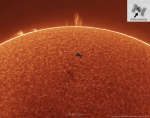 Space Station, Solar Prominences, Sun
3.05.2021
That's no sunspot. It's the International Space Station (ISS) caught passing in front of the Sun. Sunspots, individually, have a dark central umbra, a lighter surrounding penumbra, and no Dragon capsules attached.
 APOD: 2024 March 6 Б M102: Edge on Disk Galaxy
5.03.2024
What kind of celestial object is this? A relatively normal galaxy -- but seen from its edge. Many disk galaxies are actually just as thin as NGC 5866, the Spindle galaxy, pictured here, but are not seen edge-on from our vantage point. A perhaps more familiar galaxy seen edge-on is our own Milky Way galaxy.
 Comet C/2025 F2 SWAN
17.04.2025
In late March, the comet now designated C/2025 F2 SWAN was found independently by citizen scientists Vladimir Bezugly, Michael Mattiazzo, and Rob Matson while examining publicly available image data from the Solar Wind ANisotropies (SWAN) camera on the sun-staring SOHO spacecraft.
 Blue Stragglers In NGC 6397
22.06.2000
In our neck of the Galaxy stars are too far apart to be in danger of colliding, but in the dense cores of globular star clusters star collisions may be relatively common. In fact...
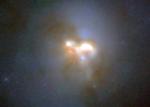 Arp 220: Spirals in Collision
17.06.1997
Arp 220 is the brightest object in the local universe. But why does it shine so brightly? Arp 220 was cataloged as a peculiar galaxy in the 1960s. In the late 1980s, it was discovered to be an ultraluminous infrared galaxy and headed a list compiled from observations with the now-defunct IRAS satellite.
|
January February |
|||||||||||||||||||||||||||||||||||||||||||||||||