
|
You entered: image
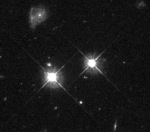 A Milestone Quasar
18.08.1996
Here is a rather typical quasar. But since quasars are so unusual it is quite atypical of most familiar objects. Of the two bright objects in the center of this photo, the quasar is on the left.
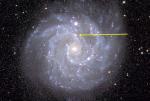 A Gamma Ray Burst Supernova Connection
14.04.2003
New evidence has emerged that a mysterious type of explosion known as a gamma ray burst is indeed connected to a supernova of the type visible in the above image. Two weeks ago, the orbiting HETE satellite detected gamma-ray burst GRB030329.
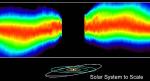 Closer To Beta Pic
22.01.1998
What did our Solar System look like as the planets were forming? Since the 1980s, astronomers have been pointing toward Beta Pictoris, a young, sun-like star a mere 50 light-years distant, as a likely example. Beta Pic is surrounded by a disk of dust which we view nearly edge-on.
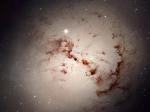 NGC 1316: After Galaxies Collide
4.04.2005
How did this strange-looking galaxy form? Astronomers turn detectives when trying to figure out the cause of unusual jumbles of stars, gas, and dust like NGC 1316. A preliminary inspection indicates that NGC 1316 is an enormous elliptical galaxy that includes dark dust lanes usually found in a spiral.
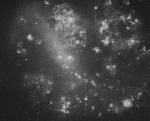 Shell Game in the LMC
18.05.2006
An alluring sight in dark southern skies, the Large Magellanic Cloud (LMC) is seen here through a narrow filter that transmits only the red light of hydrogen atoms. Ionized by energetic starlight, a hydrogen atom emits the characteristic red H-alpha light as its single electron is recaptured and transitions to lower energy states.
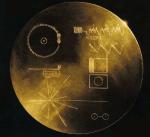 The Voyagers Message in a Bottle
8.09.2007
Launched thirty years ago, NASA's Voyager 1 and 2 spacecraft are now respectively 15 billion and 12.5 billion kilometers from the Sun, equivalent to about 14 and 11.5 light-hours distant. Still functioning, the Voyagers are being tracked and commanded through the Deep Space Network.
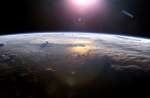 Yuri s Planet
12.04.2008
On April 12th, 1961, Soviet cosmonaut Yuri Alexseyevich Gagarin became the first human in space. His remotely controlled Vostok 1 spacecraft lofted him to an altitude of 200 miles and carried him once around planet Earth. Commenting on the first view from space he reported, "The sky is very dark; the Earth is bluish.
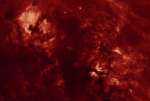 Cygnus Without Stars
24.04.2008
The sky is full of hydrogen, though it can take a sensitive camera and telescope to see it. For example, this twelve-degree-wide view of the northern part of the constellation Cygnus reveals cosmic clouds of hydrogen gas along the plane of our Milky Way galaxy.
 A Darkened Sky
20.09.2008
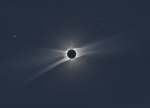
For a moment on August 1st, the daytime sky grew dark along the path of a total solar eclipse. While watching the geocentric celestial event from Mongolia, photographer Miloslav Druckmuller recorded multiple images with two separate cameras as the Moon blocked the bright solar disk and darkened the sky.
 Equinox: The Sun from Solstice to Solstice
22.09.2008
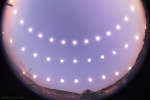
Today is an equinox, a date when day and night are equal. Tomorrow, and every day until the next equinox, the night will be longer than the day in Earth's northern hemisphere, and the day will be longer than the night in Earth's southern hemisphere.
|
January February March April May June July August September |
|||||||||||||||||||||||||||||||||||||||||||||||||