
|
You entered: orbit
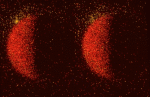 X-ray Moon and X-ray Star
27.02.1996
An X-ray star winks out behind the Moon in these before and after views of a lunar occultation of the galactic X-ray source designated GX5-1. The false color images were made using data...
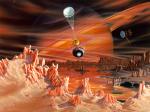 Titan Surmised
20.12.2004
What does the surface of Titan look like? Thick clouds have always made Saturn's largest moon so mysterious that seemingly farfetched hypotheses like methane rain and lakes have been seriously considered. Later this...
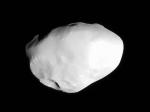 An Unusually Smooth Surface on Saturns Telesto
22.02.2006
Why is Saturn's small moon Telesto so smooth? Possibly Telesto is covered with a type of granular icy material similar to that suspected of covering Pandora, another of Saturn's small moon's. If so, Telesto might be more like a pile of rubble than a solid body.
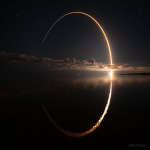 Lucy Launches to Eight Asteroids
20.10.2021
Why would this mission go out as far as Jupiter -- but then not visit Jupiter? Lucy's plan is to follow different leads about the origin of our Solar System than can be found at Jupiter -- where Juno now orbits.
 APOD: 2025 March 9 Б Cyclones at Jupiters North Pole
9.03.2025
Why are there so many cyclones around the north pole of Jupiter? The topic is still being researched. NASA's robotic Juno mission orbiting Jupiter took data in 2018 that was used to construct this stunning view of the curious cyclones at Jupiter's north pole.
 Eros Craters And Boulders
21.07.2000
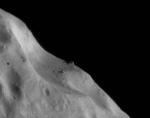
From a delicate orbit around asteroid 433 Eros, the NEAR Shoemaker spacecraft's camera has now imaged the entire surface of the small oddly-shaped world at least once. Recorded on July 7th from a distance of 50 kilometers, this dramatic view is about 1.8 kilometers across.
 M2 9: Wings of a Butterfly Nebula
1.02.2004
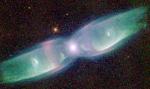
Are stars better appreciated for their art after they die? Actually, stars usually create their most artistic displays as they die. In the case of low-mass stars like our Sun and M2-9 pictured above, the stars transform themselves from normal stars to white dwarfs by casting off their outer gaseous envelopes.
 Io Shadow
23.04.1999
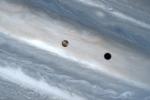
Orbiting Jupiter once every 43 hours, the volcanic moon Io cruises 500,000 kilometers above swirling, banded cloud-tops. Orbiting Earth once every 1.5 hours, the Hubble Space Telescope watched as Io accompanied by its shadow crossed the face of the reigning gas giant planet in 1997.
 The Diner at the Center of the Galaxy
30.12.2011
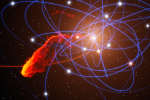
The monster at the center of our Galaxy is about to get fed. Recent observations by the Very Large Telescopes indicate that a cloud of gas will venture too close to the supermassive black hole at the Galactic center.
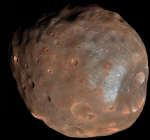 Phobos: Doomed Moon of Mars
28.10.2012
This moon is doomed. Mars, the red planet named for the Roman god of war, has two tiny moons, Phobos and Deimos, whose names are derived from the Greek for Fear and Panic. These...
|
January February March April May June July August September |
|||||||||||||||||||||||||||||||||||||||||||||||||