
|
You entered: hot gas
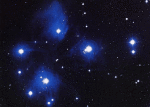 Pleiades Star Cluster
20.06.1995
The Pleiades star cluster, M45, is one of the brightest star clusters visible in the northern hemisphere. It consists of many bright, hot stars that were all formed at the same time within a large cloud of interstellar dust and gas.
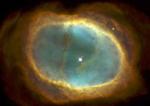 NGC 3132: The Eight Burst Nebula
10.11.1998
It's the dim star, not the bright one, near the center of NGC 3132 that created this odd but beautiful planetary nebula. Nicknamed the Eight-Burst Nebula and the Southern Ring Nebula, the glowing gas originated in the outer layers of a star like our Sun.
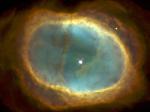 NGC 3132: The Eight Burst Nebula
6.02.2005
It's the dim star, not the bright one, near the center of NGC 3132 that created this odd but beautiful planetary nebula. Nicknamed the Eight-Burst Nebula and the Southern Ring Nebula, the glowing gas originated in the outer layers of a star like our Sun.
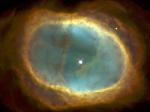 NGC 3132: The Eight Burst Nebula
13.09.2003
It's the dim star, not the bright one, near the center of NGC 3132 that created this odd but beautiful planetary nebula. Nicknamed the Eight-Burst Nebula and the Southern Ring Nebula, the glowing gas originated in the outer layers of a star like our Sun.
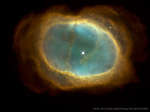 NGC 3132: The Eight Burst Nebula
7.06.2015
It's the dim star, not the bright one, near the center of NGC 3132 that created this odd but beautiful planetary nebula. Nicknamed the Eight-Burst Nebula and the Southern Ring Nebula, the glowing gas originated in the outer layers of a star like our Sun.
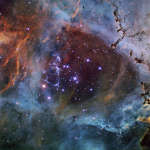 NGC 2244: A Star Cluster in the Rosette Nebula
21.02.2021
In the heart of the Rosette Nebula lies a bright open cluster of stars that lights up the nebula. The stars of NGC 2244 formed from the surrounding gas only a few million years ago.
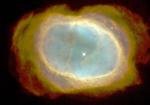 NGC 3132: The Eight Burst Nebula
24.06.2001
It's the dim star, not the bright one, near the center of NGC 3132 that created this odd but beautiful planetary nebula. Nicknamed the Eight-Burst Nebula and the Southern Ring Nebula, the glowing gas originated in the outer layers of a star like our Sun.
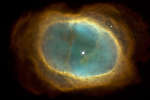 NGC 3132: The Eight Burst Nebula
26.06.2011
It's the dim star, not the bright one, near the center of NGC 3132 that created this odd but beautiful planetary nebula. Nicknamed the Eight-Burst Nebula and the Southern Ring Nebula, the glowing gas originated in the outer layers of a star like our Sun.
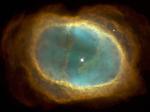 NGC 3132: The Eight Burst Nebula
14.10.2007
It's the dim star, not the bright one, near the center of NGC 3132 that created this odd but beautiful planetary nebula. Nicknamed the Eight-Burst Nebula and the Southern Ring Nebula, the glowing gas originated in the outer layers of a star like our Sun.
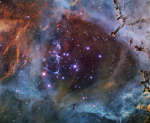 In the Heart of the Rosette Nebula
11.03.2014
In the heart of the Rosette Nebula lies a bright open cluster of stars that lights up the nebula. The stars of NGC 2244 formed from the surrounding gas only a few million years ago.
|
January February March April May June July August September |
|||||||||||||||||||||||||||||||||||||||||||||||||