
|
You entered: dust lanes
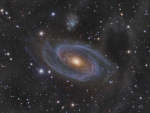 Grand Spiral Galaxy M81 and Arps Loop
16.04.2013
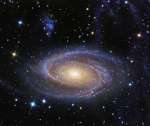
One of the brightest galaxies in planet Earth's sky is similar in size to our Milky Way Galaxy: big, beautiful M81. This grand spiral galaxy lies 11.8 million light-years away toward the northern constellation of the Great Bear (Ursa Major).
 APOD: 2023 July 9 Б Doomed Star Eta Carinae
9.07.2023
Eta Carinae may be about to explode. But no one knows when - it may be next year, it may be one million years from now. Eta Carinae's mass - about 100 times greater than our Sun - makes it an excellent candidate for a full blown supernova.
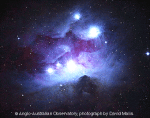 NGC 1977: Blue Reflection Nebula in Orion
1.02.1998
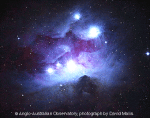
The Orion Nebula is visible to the unaided eye as a fuzzy patch near the famous belt of three stars in the constellation Orion. The above picture captures a part of the Orion Nebula that primarily reflects light from bright Orion stars.
 APOD: 2024 January 1 Б NGC 1232: A Grand Design Spiral Galaxy
1.01.2024
Galaxies are fascinating not only for what is visible, but for what is invisible. Grand spiral galaxy NGC 1232, captured in detail by one of the Very Large Telescopes, is a good example.
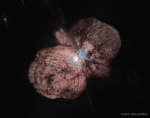 Doomed Star Eta Carinae
27.12.2015
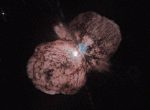
Eta Carinae may be about to explode. But no one knows when - it may be next year, it may be one million years from now. Eta Carinae's mass - about 100 times greater than our Sun - makes it an excellent candidate for a full blown supernova.
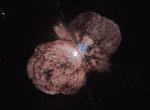 Doomed Star Eta Carinae
12.07.1997
Eta Carinae may be about to explode. But no one knows when - it may be next year, it may be one million years from now. Eta Carinae's mass - about 100 times greater than our Sun - make it an excellent candidate for a full blown supernova.
 Doomed Star Eta Carinae
11.06.1996
Eta Carinae may be about to explode. But no one knows when - it may be next year, it may be one million years from now. Eta Carinae's mass - about 100 times greater than our Sun - make it an excellent candidate for a full blown supernova.
 M51: Tidal Streams and H-alpha Ciffs
13.12.2024
An intriguing pair of interacting galaxies, M51 is the 51st entry in Charles Messier's famous catalog. Perhaps the original spiral nebula, the large galaxy with whirlpool-like spiral structure seen nearly face-on is also cataloged as NGC 5194. Its spiral arms and dust lanes sweep in front of its smaller companion galaxy, NGC 5195.
 NGC 1977: Blue Reflection Nebula in Orion
20.03.1996
The Orion Nebula is visible to the unaided eye as a fuzzy patch near the famous belt of three stars in the constellation Orion. The above picture captures a part of the Orion Nebula that primarily reflects light from bright Orion stars.
 M81 and Arp s Loop
9.12.2010
One of the brightest galaxies in planet Earth's sky and similar in size to the Milky Way, big, beautiful spiral M81 lies 11.8 million light-years away in the northern constellation Ursa Major. This...
|
January February March April May June July August |
||||||||||||||||||||||||||||||||||||||||||||||||||||||||