
|
You entered: Solar System
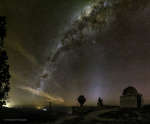 Milky Way over Bosque Alegre Station in Argentina
22.09.2015
What are those streaks of light in the sky? First and foremost, the arching structure is the central band of our Milky Way galaxy. Visible in this galactic band are millions of distant stars mixed with numerous lanes of dark dust.
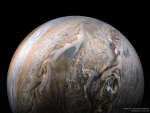 Tumultuous Clouds of Jupiter
6.01.2020
Some cloud patterns on Jupiter are quite complex. The featured tumultuous clouds were captured in May by NASA's robotic Juno spacecraft currently orbiting our Solar System's largest planet. The image was taken...
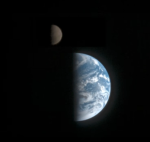 Earth and Moon
5.09.2021
The Earth and Moon are rarely photographed together. One of most spectacular times this occurred was about 30 years ago when the Jupiter-bound Galileo spacecraft zoomed past our home planetary system. Then, robotic Galileo watched from about 15-times the Earth-Moon separation as our only natural satellite glided past our home world.
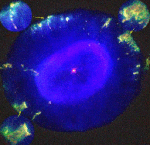 Fliers Around the Blue Snowball Nebula
22.11.1996
Planetary nebulae are strange. First, they are gas clouds and have nothing to do with our Solar System's planets. Next, although hundreds of planetary nebulae have been catalogued and thousands surely exist in our Galaxy, aspects of the formation process are still debated.
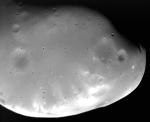 Deimos: A Small Martian Moon
4.01.2004
Mars has two tiny moons, Phobos and Deimos. Pictured above is Deimos, the smaller moon of Mars. In fact, Deimos is one of the smallest known moons in the Solar System measuring only nine miles across.
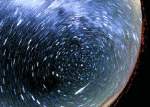 Leonid Meteor Shower Next Week
8.11.1998
Early next week, a spectacular meteor storm is expected: the 1998 Leonids. It is widely thought that that the meteors from the Leonids meteor shower are just small pieces of Comet Temple-Tuttle falling to Earth.
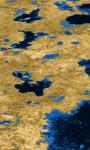 Liquid Lakes on Saturns Titan
7.02.2007
Why would some regions on Titan reflect very little radar? The leading explanation is that these regions are lakes, possibly composed of liquid methane. The above image is a false-color synthetic radar map of a northern region of Titan taken during a flyby of the cloudy moon by the robotic Cassini spacecraft last July.
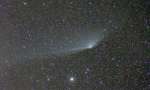 Comet PanSTARRS with Anti Tail
18.05.2013
Once the famous sunset comet, PanSTARRS (C/2011 L4) is now visible all night from much of the northern hemisphere, bound for the outer solar system as it climbs high above the ecliptic plane. Dimmer and fading, the comet's broad dust tail is still growing, though.
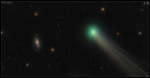 Comet Lovejoy Before Galaxy M63
2.12.2013
Comet Lovejoy was captured last week passing well in front of spiral galaxy M63. Discovered only three months ago and currently near its maximum brightness, Comet Lovejoy can be seen near the Big Dipper from dark northerly locations before dawn with the unaided eye.
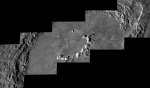 The Great Crater Hokusai
18.04.2015
One of the largest young craters on Mercury, 114 kilometer (71 mile) diameter Hokusai crater's bright rays are known to extend across much of the planet. But this mosaic of oblique views focuses...
|
January February March April May June July August September |
|||||||||||||||||||||||||||||||||||||||||||||||||