
|
You entered: Earth's moon
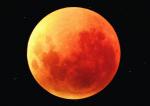 Lingering Lunar Eclipse
26.07.2000
As the Moon passed almost directly through the center of Earth's shadow on July 16th, sky gazers in the Pacific hemisphere were graced by a lingering lunar eclipse. The total phase lasted 1 hour and 47 minutes, the longest since 1859. A longer total lunar eclipse won't occur until the year 3000.
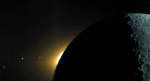 The Ecliptic Plane
27.09.1997
The Plane of the Ecliptic is illustrated in this Clementine star tracker camera image which reveals (from right to left) the Moon lit by Earthshine, the Sun's corona rising over the Moon's dark limb, and the planets Saturn, Mars, and Mercury.
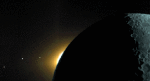 The Ecliptic Plane
29.05.1999
The Plane of the Ecliptic is illustrated in this Clementine star tracker camera image which reveals (from right to left) the Moon lit by Earthshine, the Sun's corona rising over the Moon's dark limb, and the planets Saturn, Mars, and Mercury.
 Moon O Clock 2022
6.01.2023
The first Full Moon of 2023 is in the sky tonight opposite the Sun at 23:08 UTC. Big and beautiful, the Moon at its brightest phase should be easy to spot. Still...
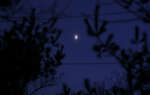 An Unusual Venusian Oval
13.02.2012
Why would Venus appear oval? Venus has been seen countless times from the surface of the Earth, and every time the Earth's atmosphere has dispersed its light to some degree. When...
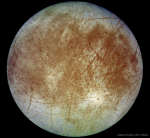 Jupiters Europa from Spacecraft Galileo
27.09.2016
What mysteries might be solved by peering into this crystal ball? In this case, the ball is actually a moon of Jupiter, the crystals are ice, and the moon is not only dirty but cracked beyond repair. Nevertheless, speculation is rampant that oceans exist under Europa's fractured ice-plains that could support life.
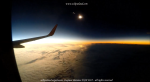 Through the Shadow of the Moon
14.04.2015
What would it look like to fly through a total eclipse of the Sun? On a typical place on Earth in the path of the dark shadow of the Moon during a total eclipse, an observer would see the Moon cross the face of the Sun, completely blocking it for a few minutes.
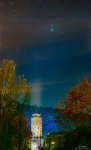 December s Comet Wirtanen
7.12.2018
Coming close in mid-December, Comet 46P Wirtanen hangs in this starry sky over the bell tower of a Romanesque church. In the constructed vertical panorama, a series of digital exposures capture its greenish coma on December 3 from Sant Llorenc de la Muga, Girona, Catalonia, Spain, planet Earth.
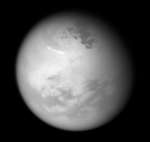 Northern Summer on Titan
22.06.2017
While yesterday's solstice brought summer to planet Earth's northern hemisphere, a northern summer solstice arrived for ringed planet Saturn nearly a month ago on May 24. Following the Saturnian seasons, its large moon Titan was captured in this Cassini spacecraft image from June 9.
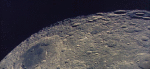 Lunar Farside from Apollo 13
7.07.1995
In April of 1970, after an explosion damaged their spacecraft, the Apollo 13 astronauts were forced to abandon their plans to make the third manned lunar landing. Still, while coasting around the moon in their desperate attempt to return to earth they were able to photograph the moon's far side.
|
January February March April May June July August September |
|||||||||||||||||||||||||||||||||||||||||||||||||