
|
You entered: image
 Pandora s Cluster of Galaxies
9.06.2023
This deep field mosaicked image presents a stunning view of galaxy cluster Abell 2744 from the James Webb Space Telescope's NIRCam. Also dubbed Pandora's Cluster, Abell 2744 itself appears to be a ponderous merger of three different massive galaxy clusters some 3.5 billion light-years away toward the constellation Sculptor.
 M100: A Grand Design Spiral Galaxy
2.05.2024
Majestic on a truly cosmic scale, M100 is appropriately known as a grand design spiral galaxy. The large galaxy of over 100 billion stars has well-defined spiral arms, similar to our own Milky Way.
 Small Moon Deimos
7.09.2024
Mars has two tiny moons, Phobos and Deimos, named for the figures in Greek mythology Fear and Panic. Detailed surface views of smaller moon Deimos are shown in both these panels. The images were taken in 2009, by the HiRISE camera on board the Mars Reconnaissance Orbiter spacecraft, NASA's long-lived interplanetary internet satellite.
 APOD: 2025 January 26 Б The Many Tails of Comet G3 ATLAS
26.01.2025
Why does this comet have so many tails? C/2024 G3 (ATLAS) has developed several long and intricate tails visible from Earth's southern hemisphere over the past two weeks. Many observers reported seeing the impressive comet without any optical aid above the western horizon just after sunset.
 Herbig Haro 24
28.05.2025
This might look like a double-bladed lightsaber, but these two cosmic jets actually beam outward from a newborn star in a galaxy near you. Constructed from Hubble Space Telescope image data, the stunning scene...
 APOD: 2025 August 2 Б Fireflies, Meteors, and Milky Way
2.08.2025
Taken on July 29 and July 30, a registered and stacked series of exposures creates this dreamlike view of a northern summer night. Multiple firefly flashes streak across the foreground as the luminous Milky...
 APOD: 2025 December 14 Б Juno Flyby of Ganymede and Jupiter
14.12.2025
What would it be like to fly over the largest moon in the Solar System? In 2021, the robotic Juno spacecraft flew past Jupiter's huge moon Ganymede and took images that have been digitally constructed into a detailed flyby.
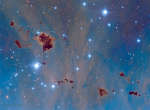 APOD: 2026 May 25 Б Thackerays Globules
25.05.2026
What are these strange space globs? Situated in rich star fields and glowing hydrogen gas, these opaque clouds of interstellar dust and gas are so large they might be able to form stars. Their...
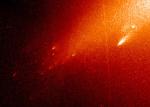 Comet LINEAR Disperses
8.08.2000
What's happened to the nucleus of Comet LINEAR? The brightest comet this year has unexpectedly broken up into many smaller pieces. The break-up occurred on or about July 25 and was noted by many astronomers around the world with particularly pioneering work by Mark Kidger (IAC).
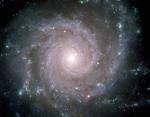 M74: The Perfect Spiral
4.10.2001
If not perfect, then this spiral galaxy is at least one of the most photogenic. An island universe of about 100 billion stars, 30 million light-years away toward the constellation Pisces, NGC 628 or M74 presents a gorgeous face-on view to earthbound astronomers.
|
January February March April May June July August September |
|||||||||||||||||||||||||||||||||||||||||||||||||