
|
You entered: nearest stars
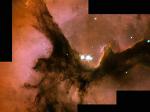 The Trifid Nebula from Hubble
18.06.2004
Clouds of glowing gas mingle with lanes of dark dust in the Trifid Nebula, a star forming region toward the constellation of Sagittarius. In the center, the three huge dark dust lanes that give the Trifid its name all come together.
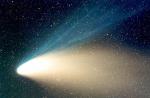 A Star Cluster Through Hale-Bopp's Tail
16.04.1997
Comet Hale-Bopp continues to look impressive. The photograph above captured the comet on April 7th passing nearly in front of M34, a star cluster in the constellation of Perseus. Many of the stars in this open cluster can be seen through Comet Hale-Bopp's white dust tail.
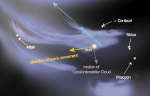 The Local Fluff
29.08.2010
The stars are not alone. In the disk of our Milky Way Galaxy about 10 percent of visible matter is in the form of gas, called the interstellar medium (ISM). The ISM is not uniform, and shows patchiness even near our Sun.
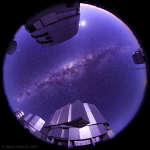 A Milky Way Dawn
29.03.2014
As dawn broke on March 27, the center of the Milky Way Galaxy stood almost directly above the European Southern Observatory's Paranal Observatory. In the dry, clear sky of Chile's Atacama desert...
 Comet and Meteor
4.01.2009
This meteor streaking toward the horizon through the early morning sky of January 3rd is from the annual Quadrantid meteor shower. Aligned with the shower's radiant point high in the north (off the top of the view), the meteor trail passes to the right of bright bluish star Beta Scorpii.
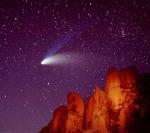 Hale-Bopp from Indian Cove
6.08.1997
Good cameras were able to obtain impressive photographs of Comet Hale-Bopp when at its brightest earlier this year. In the above photograph taken April 5th, Comet Hale-Bopp was imaged from the Indian Cove Campground in the Joshua Tree National Forest in California, USA.
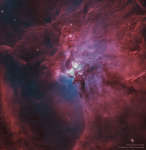 The Lively Center of the Lagoon Nebula
31.05.2020
The center of the Lagoon Nebula is a whirlwind of spectacular star formation. Visible near the image center, at least two long funnel-shaped clouds, each roughly half a light-year long, have been formed by extreme stellar winds and intense energetic starlight. A tremendously bright nearby star, Hershel 36, lights the area.
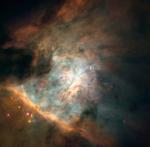 M42: A Mosaic of Orion's Great Nebula
22.05.1999
The Great Nebula in Orion, an immense, nearby starbirth region, is probably the most famous of all astronomical nebulae. Here, 15 pictures from the Hubble Space Telescope have been mosaicked to cover the inner 2.5 light years of the nebula and illustrate its diverse nature.
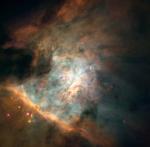 M42: A Mosaic of Orion's Great Nebula
11.05.1997
The Great Nebula in Orion, an immense, nearby starbirth region, is probably the most famous of all astronomical nebulae. Here, 15 pictures from the Hubble Space Telescope have been mosaicked to cover the inner 2.5 light years of the nebula and illustrate its diverse nature.
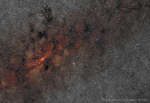 The Galactic Center in Infrared
16.01.2016
The center of our Galaxy is a busy place. In visible light, much of the Galactic Center is obscured by opaque dust. In infrared light, however, dust glows more and obscures less, allowing nearly one million stars to be recorded in the featured photograph.
|
January February March April May June July August September October |
|||||||||||||||||||||||||||||||||||||||||||||||||