
|
You entered: Earth's atmosphere
 High Energy Stereoscopic System II
27.07.2012
The largest of its kind, the High Energy Stereoscopic System (H.E.S.S.) II telescope stands in the foreground of this photo. Tilted horizontally it reflects the inverted landscape of the Namibian desert in a segmented mirror 24 meters wide and 32 meters tall, equal in area to two tennis courts.
 A World Explorer
25.08.1995
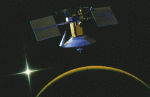
Ferdinand Magellan was a world explorer. Many consider him the greatest navigator of Europe's 16th century age of sea going exploration and credit his expedition with the first circumnavigation of planet Earth. NASA...
 A Perseid Below
9.08.2024
Denizens of planet Earth typically watch meteor showers by looking up. But this remarkable view, captured on August 13, 2011 by astronaut Ron Garan, caught a Perseid meteor by looking down. From Garan...
 A Perseid Below
10.08.2014
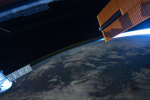
Denizens of planet Earth typically watch meteor showers by looking up. But this remarkable view, captured on August 13, 2011 by astronaut Ron Garan, caught a Perseid meteor by looking down. From Garan...
 Strawberry Supermoon Over Devils Saddle
4.07.2022
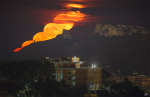
Near the horizon the full moon often seems to loom large, swollen in appearance by the famous Moon illusion. But time-lapse image sequences demonstrate that the Moon's angular size doesn't really change as it rises or sets. Its color does, though.
 A Filament Leaps from the Sun
8.11.2021
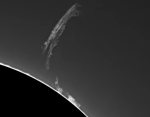
Why, sometimes, does part of the Sun's atmosphere leap into space? The reason lies in changing magnetic fields that thread through the Sun's surface. Regions of strong surface magnetism, known as active regions, are usually marked by dark sunspots.
 A Perseid Below
8.08.2021
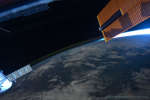
Earthlings typically watch meteor showers by looking up. But this remarkable view, captured on August 13, 2011 by astronaut Ron Garan, caught a Perseid meteor by looking down. From Garan's perspective onboard...
 Aurora and Orion
26.01.1997
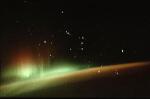
Looking toward the south from low Earth orbit, the crew of the Space Shuttle Endeavor made this stunning time exposure of the Aurora Australis or southern lights in April of 1994. Aurora are visible at high northern latitudes as well, with the northern lights known as Aurora Borealis.
 Moon Over Eugenia
14.10.1999
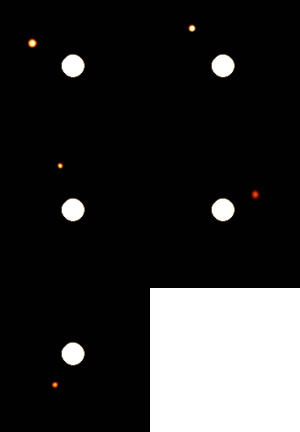
Eugenia is an asteroid with a moon! This animation was constructed from infrared discovery images of the Eugenia-moon system taken in November 1998 using the Canada-France-Hawaii Telescope (CFHT). Main belt asteroid Eugenia, represented here as a central white patch, is a mere 215 kilometers in diameter.
 Blood Monster Moon
4.06.2021
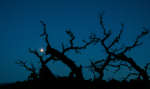
On May 26, the Full Flower Moon was caught in this single exposure as it emerged from Earth's shadow and morning twilight began to wash over the western sky. Posing close...
|
January February |
|||||||||||||||||||||||||||||||||||||||||||||||||