
|
You entered: star system
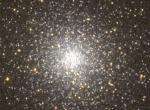 Globular Cluster 47 Tucanae
7.11.1998
Stars come in bunches. Of the over 200 globular star clusters that orbit the center of our Milky Way Galaxy, 47 Tucanae is the second brightest globular cluster (behind Omega Centauri). Known to some affectionately as 47 Tuc or NGC 104, it is only visible from the Southern
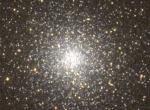 Globular Cluster 47 Tucanae
19.09.1997
Stars come in bunches. Of the over 200 globular star clusters that orbit the center of our Milky Way Galaxy, 47 Tucanae is the second brightest globular cluster (behind Omega Centauri). Known to some affectionately as 47 Tuc or NGC 104, it is only visible from the Southern Hemisphere.
 APOD: 2025 October 20 Б Finding Comet Lemmon
20.10.2025
Tonight, if you can see the stars of the Big Dipper, then you can find comet Lemmon in your evening sky. After sunset, look for the faint but extended comet above your northwestern horizon -- but below the handle of the famous celestial kitchen utensil of the north.
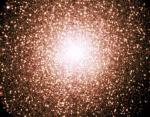 Globular Cluster 47 Tucanae from SALT
5.09.2005
Stars come in bunches. Of the over 200 globular star clusters that orbit the center of our Milky Way Galaxy, 47 Tucanae is the second brightest globular cluster, behind Omega Centauri. Known to some affectionately as 47 Tuc or NGC 104, it is only visible from Earth's Southern Hemisphere.
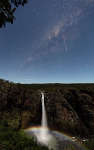 Meteor and Moonbow over Wallaman Falls
12.11.2012
Which feature takes your breath away first in this encompassing panorama of land and sky? The competition is strong with a waterfall, meteor, starfield, and even a moonbow all vying for attention. It is interesting to first note, though, what can't be seen -- a rising moon on the other side of the camera.
 Mobius Arch Moonrise
28.02.2014
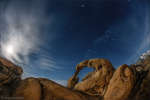
Only two days past full, February's moon shines through thin clouds, rising on the left in this fisheye night skyscape. The moonlight illuminates a weathered, rounded foreground in the Alabama Hills, conveniently located east of Mt. Whitney along the Sierra Nevada range in California, USA, planet Earth.
 Reflections on VdB 31
13.02.2025
Riding high in the constellation of Auriga, beautiful, blue VdB 31 is the 31st object in Sidney van den Bergh's 1966 catalog of reflection nebulae. It shares this well-composed celestial still life with dark, obscuring clouds B26, B27, and B28, recorded in Edward E. Barnard's 1919 catalog of dark markings in the sky.
 Zodiacal Light before Dawn
11.09.2014
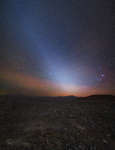
You might not guess it, but sunrise was still hours away when this nightscape was taken, a view along the eastern horizon from a remote location in Chile's Atacama desert. Stretching high into...
 Our Solar System from Voyager
19.08.1995
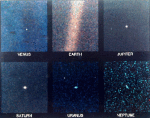
After taking its spectacular pictures of the outer solar system planets, Voyager 1 looked back at six planets from the inner solar system. Here Venus, Earth, Jupiter, Saturn, Uranus, and Neptune, were all visible across the sky.
 Full Throttle For Deep Space 1
31.08.2000
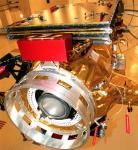
At full throttle the Deep Space 1 spacecraft's innovative ion drive produces about 1/50th of a pound of thrust ... a force so great that it would just about hold up a piece of paper on planet Earth! Still, powered by solar arrays ion propulsion systems can run continuously.
|
January February March April May June |
|||||||||||||||||||||||||||||||||||||||||||||||||