
|
You entered: shadow
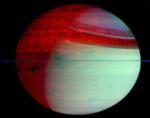 Saturn s Infrared Glow
12.10.2006
Known for its bright ring system and many moons, gas giant Saturn looks strange and unfamiliar in this false-color view from the Cassini spacecraft. In fact, in this Visual and Infrared Mapping Spectrometer (VIMS) mosaic the famous rings are almost invisible, seen edge-on cutting across picture center.
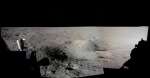 Apollo 11 Landing Site Panorama
30.08.2012
Have you seen a panorama from another world lately? Assembled from high-resolution scans of the original film frames, this one sweeps across the magnificent desolation of the Apollo 11 landing site on the Moon's Sea of Tranquility.
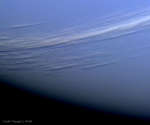 Two Hours Before Neptune
14.02.2015
Two hours before closest approach to Neptune in 1989, the Voyager 2 robot spacecraft snapped this picture. Clearly visible for the first time were long light-colored cirrus-type clouds floating high in Neptune's atmosphere. Shadows of these clouds can even be seen on lower cloud decks.
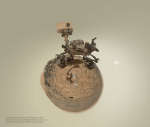 Little Planet Curiosity
22.08.2015
A curious robot almost completely straddles this rocky little planet. Of course, the planet is really Mars and the robot is the car-sized Curiosity Rover, posing over its recent drilling target in the Marias Pass area of lower Mount Sharp.
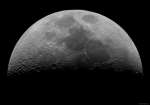 The Lunar X
1.03.2018
The striking X in this lunarscape is easily visible in binoculars or a small telescope, but not too many have seen it. The catch is, this lunar X is fleeting and only apparent in the hours before the Moon's first quarter phase.
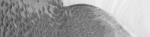 A Martian Metamorphosis
4.06.2002
Is it an Escher, or Mars? Three different types of surfaces visible in the North Polar Cap of Mars morph into each other in a way perhaps reminiscent of the works of M. C. Escher. On the far left dark sand covers the ground, while the center shows a transition to a dune field.
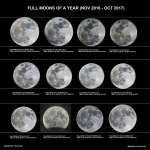 A Year of Full Moons
5.11.2017
Do all full moons look the same? No. To see the slight differences, consider this grid of twelve full moons. From upper left to lower right, the images represent every lunation from 2016 November through 2017 October, as imaged from Pakistan.
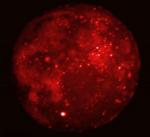 Eclipsed Moon in Infrared
15.09.2001
The total lunar eclipse of September 1996 disappointed many observers in North America who were cursed with cloudy skies. However, the Midcourse Space Experiment (MSX) satellite had a spectacular view from Earth orbit and SPIRIT III, an onboard infrared telescope, was used to repeatedly image the moon during the eclipse.
 Penumbral Lunar Eclipse
12.10.2016
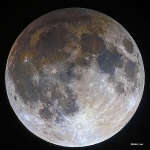
Does this Moon look a little different to you? Although shown in spectacular detail, the full face of Earth's most familiar satellite appears slightly darker than usual, in particular on the upper left, because it is undergoing a penumbral lunar eclipse.
 Juno Spots a Complex Storm on Jupiter
28.11.2017
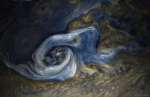
Some storms on Jupiter are quite complex. The swirling storm was captured late last month by the NASA's robotic Juno spacecraft currently orbiting the Solar System's largest planet. The featured image spans about 30,000 kilometers, making this storm system just about as wide as planet Earth.
|
January February March April May June July August September |
|||||||||||||||||||||||||||||||||||||||||||||||||