
|
You entered: nearest stars
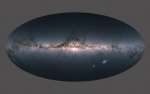 Gaia's Milky Way
27.04.2018
This grand allsky view of our Milky Way and nearby galaxies is not a photograph. It's a map based on individual measurements for nearly 1.7 billion stars. The astronomically rich data set used...
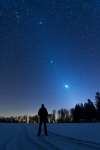 A Zodiacal Skyscape
23.02.2012
Venus and Jupiter are this month's two brightest planets. Shortly after sunset on February 20, they dominate the sky above the western horizon and this snowy landscape. In clear and transparent skies over Cherry Springs State Park, Pennsylvania, USA, they are also seen immersed in Zodiacal light.
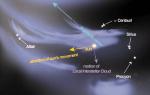 The Local Interstellar Cloud
10.02.2002
The stars are not alone. In the disk of our Milky Way Galaxy about 10 percent of visible matter is in the form of gas, called the interstellar medium (ISM). The ISM is not uniform, and shows patchiness even near our Sun.
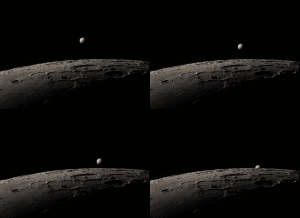 Lunar Occultation of Venus
2.06.2022
On May 27 Venus rose as the morning star, near the waning crescent Moon in a predawn sky already full of planets. It was close on the sky to the Moon's crescent and a conjunction of the second an third brightest celestial beacons were enjoyed by skygazers around the world.
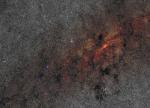 The Galactic Center in Infrared
16.07.2006
The center of our Galaxy is a busy place. In visible light, much of the Galactic Center is obscured by opaque dust. In infrared light, however, dust glows more and obscures less, allowing nearly one million stars to be recorded in the above photograph.
 NGC 1365: Majestic Island Universe
1.02.2024
Barred spiral galaxy NGC 1365 is truly a majestic island universe some 200,000 light-years across. Located a mere 60 million light-years away toward the faint but heated constellation Fornax, NGC 1365 is a dominant member of the well-studied Fornax Cluster of galaxies.
 Eclipse in the City
12.11.2022
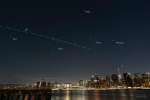
A darker Moon sets over Manhattan in this night skyscape. The 16 frame composite was assembled from consecutive exposures recorded during the November 8 total lunar eclipse. In the timelapse sequence stars leave short trails above the urban skyline, while the Moon remains immersed in Earth's shadow.
 Gemini s Meteors
22.12.2017
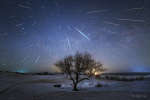
From dark skies above Heilongjiang province in northeastern China, meteors rain down on a wintry landscape in this beautiful composited night scene. The 48 meteors are part of last week's annual Geminid meteor shower.
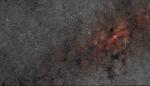 The Galactic Center in Infrared
21.06.1999
The center of our Galaxy is a busy place. In visible light, much of the Galactic Center is obscured by opaque dust. In infrared light, however, dust glows more and obscures less, allowing nearly one million stars to be recorded in the above photograph.
 APOD: 2025 December 15 Б Gemini Meteors over Snow Capped Mountains
15.12.2025
Where are all of these meteors coming from? In terms of direction on the sky, the pointed answer is the constellation of Gemini. That is why the major meteor shower in December is known as the Geminids -- because shower meteors all appear to come from a radiant toward Gemini.
|
January February March April May June July August September October |
|||||||||||||||||||||||||||||||||||||||||||||||||