
|
You entered: hot star
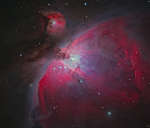 At the Heart of Orion
12.03.2017
Near the center of this sharp cosmic portrait, at the heart of the Orion Nebula, are four hot, massive stars known as the Trapezium. Tightly gathered within a region about 1.5 light-years in radius, they dominate the core of the dense Orion Nebula Star Cluster.
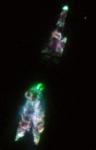 Emerging Planetary Nebula CRL 618
6.09.2000
CRL 618 may look to some like an Olympian declaring victory. Only a few hundred years ago, however, CRL 618 appeared as a relatively modest red giant star. Since then it has run out of core material to fuse and so has started to become a planetary nebula.
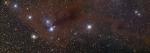 Stars and Dust Across Corona Australis
3.04.2006
A cosmic dust cloud sprawls across a rich field of stars in this gorgeous wide field telescopic vista looking toward Corona Australis, the Southern Crown. Probably less than 500 light-years away and effectively blocking...
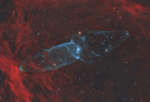 Ou4: The Giant Squid Nebula
12.10.2022
A mysterious squid-like cosmic cloud, this nebula is very faint, but also very large in planet Earth's sky. In the image, composed with 30 hours of narrowband image data, it spans nearly three full moons toward the royal constellation Cepheus.
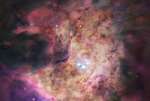 At the Heart of Orion
6.10.2012
Near the center of this sharp cosmic portrait, at the heart of the Orion Nebula, are four hot, massive stars known as the Trapezium. Gathered within a region about 1.5 light-years in radius, they dominate the core of the dense Orion Nebula Star Cluster.
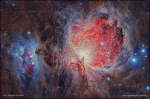 M42: The Great Orion Nebula
29.11.2017
Few astronomical sights excite the imagination like the nearby stellar nursery known as the Orion Nebula. The Nebula's glowing gas surrounds hot young stars at the edge of an immense interstellar molecular cloud.
 APOD: 2025 February 3 Б Wolf Rayet Star 124: Stellar Wind Machine
3.02.2025
Some stars explode in slow motion. Rare, massive Wolf-Rayet stars are so tumultuous and hot that they are slowly disintegrating right before our telescopes. Glowing gas globs each typically over 30 times more massive than the Earth are being expelled by violent stellar winds.
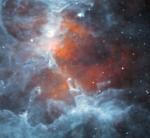 Cold Dust in the Eagle Nebula
14.09.2001
Stars are born in M16's Eagle Nebula, a stellar nursery 7,000 light-years from Earth toward the constellation Serpens. The striking nebula's star forming pillars of gas and dust are familiar to astronomers from images at visible wavelengths, but this false-color picture shows off the nebula in infrared light.
 APOD: 2023 April 2 Б M57: The Ring Nebula from Hubble
2.04.2023
It was noticed hundreds of years ago by stargazers who could not understand its unusual shape. It looked like a ring on the sky. Except for the rings of Saturn, the Ring Nebula (M57) may be the most famous celestial circle.
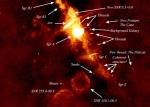 The Galactic Center A Radio Mystery
3.08.2002
Tuning in to the center of our Milky Way galaxy, radio astronomers explore a complex, mysterious place. A premier high resolution view, this startlingly beautiful picture covers a 4x4 degree region around the galactic center.
|
January February |
|||||||||||||||||||||||||||||||||||||||||||||||||