
|
You entered: galaxy center
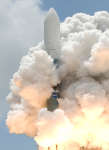 At Last GLAST
11.06.2018
Rising through a billowing cloud of smoke, a long time ago from a planet very very close by, this Delta II rocket left Cape Canaveral Air Force Station's launch pad 17-B at 12:05 pm EDT on June 11, 2008. Snug in the payload section was GLAST, the Gamma-ray Large Area Space Telescope.
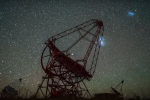 HESS Telescopes Explore the High Energy Sky
8.01.2019
They may look like modern mechanical dinosaurs but they are enormous swiveling eyes that watch the sky. The High Energy Stereoscopic System (H.E.S.S.) Observatory is composed of four 12-meter reflecting-mirror telescopes surrounding a larger telescope housing a 28-meter mirror.
 Galaxy Cluster Abell 370 and Beyond
12.09.2023
Some 4 billion light-years away, massive galaxy cluster Abell 370 is captured in this sharp Hubble Space Telescope snapshot. The cluster of galaxies only appears to be dominated by two giant elliptical galaxies and infested with faint arcs.
 APOD: 2023 September 6 Б HESS Telescopes Explore the High Energy Sky
6.09.2023
They may look like modern mechanical dinosaurs, but they are enormous swiveling eyes that watch the sky. The High Energy Stereoscopic System (H.E.S.S.) Observatory is composed of four 12-meter reflecting-mirror telescopes surrounding a larger telescope housing a 28-meter mirror.
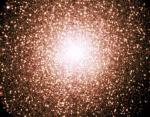 Globular Cluster 47 Tucanae from SALT
5.09.2005
Stars come in bunches. Of the over 200 globular star clusters that orbit the center of our Milky Way Galaxy, 47 Tucanae is the second brightest globular cluster, behind Omega Centauri. Known to some affectionately as 47 Tuc or NGC 104, it is only visible from Earth's Southern Hemisphere.
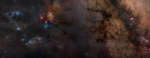 Dark River Wide Field
19.07.2010
A Dark River of dust seems to run from our Galactic Center, then pool into a starfield containing photogenic sky wonders. Scrolling right will reveal many of these objects including (can you find?)...
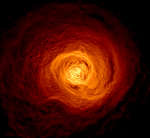 The Perseus Cluster Waves
4.05.2017
The cosmic swirl and slosh of giant waves in an enormous reservoir of glowing hot gas are traced in this enhanced X-ray image from the Chandra Observatory. The frame spans over 1 million light-years across the center of the nearby Perseus Galaxy Cluster, some 240 million light-years distant.
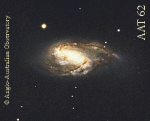 Unusual Spiral Galaxy M66
10.08.1996
Spiral galaxy M66 is largest galaxy in the a group known as the Leo Triplet. M66 is somewhat peculiar because of its asymmetric spiral arms. Usually dense waves of gas, dust, and newly formed stars - called spiral density waves - circle a galactic center and create a symmetric galaxy.
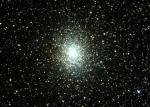 Globular Cluster M19
19.07.2000
M19 appears to be a typical globular cluster of stars - except for its shape. If one looks closely at the cluster, pictured above, it appears to be longer (top to bottom) than it is wide.
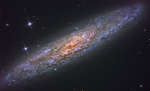 NGC 253: Dusty Island Universe
21.11.2009
Shiny NGC 253 Galaxy, is one of the brightest spiral galaxies visible, and also one of the dustiest. Some call it the Silver Dollar Galaxy for its appearance in small telescopes, or just the Sculptor Galaxy for its location within the boundaries of the southern constellation Sculptor.
|
January February March April May June July August |
||||||||||||||||||||||||||||||||||||||||||||||||||||||||