
|
You entered: explosion
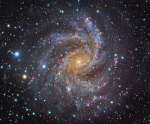 Facing NGC 6946
24.02.2018
From our vantage point in the Milky Way Galaxy, we see NGC 6946 face-on. The big, beautiful spiral galaxy is located just 10 million light-years away, behind a veil of foreground dust and stars in the high and far-off constellation of Cepheus.
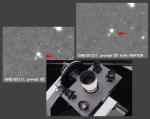 RAPTOR Images GRB 021211
19.12.2002
On December 11 astronomers found one of the brightest and most distant explosions in the Universe - a gamma-ray burst - hiding in the glare of a relatively nearby star. The earliest image of the burst's visible light was caught by an earthbound RAPTOR (RAPid Telescopes for Optical Response).
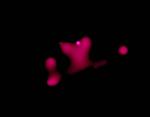 The Heart in NGC 346
14.02.2003
Yes, it's Valentine's Day (!) and looking toward star cluster NGC 346 in our neighboring galaxy the Small Magellanic Cloud, astronomers have noted this heart-shaped cloud of hot, x-ray emitting gas in the cluster's central region.
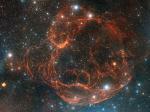 Simeis 147: Supernova Remnant from Palomar
29.11.2005
It's easy to get lost following the intricate filaments in this detailed image of faint supernova remnant Simeis 147. Seen towards the constellation Taurus it covers nearly 3 degrees (6 full moons) on the sky corresponding to a width of 150 light-years at the stellar debris cloud's estimated distance of 3,000 light-years.
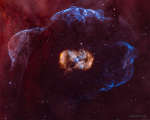 NGC 6164: Dragons Egg Nebula and Halo
26.12.2022
The star at the center created everything. Known as the Dragon's Egg, this star -- a rare, hot, luminous O-type star some 40 times as massive as the Sun -- created not only the complex nebula (NGC 6164) that immediately surrounds it, but also the encompassing blue halo.
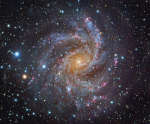 Facing NGC 6946
9.01.2012
From our vantage point in the Milky Way Galaxy, we see NGC 6946 face-on. The big, beautiful spiral galaxy is located just 10 million light-years away, behind a veil of foreground dust and stars in the high and far-off constellation of Cepheus.
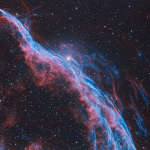 NGC 6960: The Witch s Broom Nebula
29.05.2013
Ten thousand years ago, before the dawn of recorded human history, a new light would have suddenly have appeared in the night sky and faded after a few weeks. Today we know this light was from a supernova, or exploding star, and record the expanding debris cloud as the Veil Nebula, a supernova remnant.
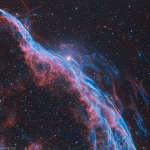 NGC 6960: The Witchs Broom Nebula
8.04.2018
Ten thousand years ago, before the dawn of recorded human history, a new light would have suddenly have appeared in the night sky and faded after a few weeks. Today we know this light was from a supernova, or exploding star, and record the expanding debris cloud as the Veil Nebula, a supernova remnant.
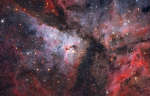 The Great Carina Nebula
27.12.2018
A jewel of the southern sky, the Great Carina Nebula, also known as NGC 3372, spans over 300 light-years, one of our galaxy's largest star forming regions. Like the smaller, more northerly Great...
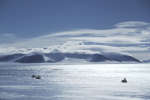 APOD: 2011 December 11 Searching for Meteorites in Antarctica
11.12.2011
Where is the best place on Earth to find meteorites? Although meteors fall all over the world, they usually just sink to the bottom of an ocean, are buried by shifting terrain, or are easily confused with terrestrial rocks.
|
January February March April May June July August September October |
|||||||||||||||||||||||||||||||||||||||||||||||||