
|
You entered: Earth orbit
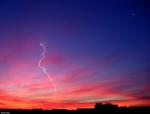 Minotaur Dawn
21.12.2006
Last Saturday, some colorful dawn skies along the US east coast featured the Moon and a Minotaur rocket climbing into low Earth orbit. The 7AM launch of the four stage Air Force Minotaur I rocket took place at NASA's Wallops Flight Facility on Virginia's eastern shore.
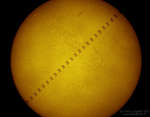 ISS and Mercury Too
13.05.2016
Transits of Mercury are relatively rare. Monday's leisurely 7.5 hour long event was only the 2nd of 14 Mercury transits in the 21st century. If you're willing to travel, transits of the International Space Station can be more frequent though, and much quicker.
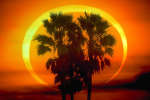 Annular Eclipse: The Ring of Fire
25.01.2009
Tomorrow, a few lucky people may see a "ring of fire." That's a name for the central view of an annular eclipse of the Sun by the Moon. At the peak of this...
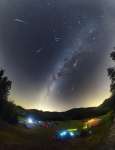 Night of the Perseids
10.08.2017
This weekend, meteors will rain down near the peak of the annual Perseid Meteor Shower. Normally bright and colorful, the Perseid shower meteors are produced by dust swept up by planet Earth from the orbit of Comet Swift-Tuttle. They streak from a radiant in Perseus, above the horizon in clear predawn skies.
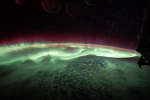 Aurora Slathers Up the Sky
4.01.2020
Like salsa verde on your favorite burrito, a green aurora slathers up the sky in this 2017 June 25 snapshot from the International Space Station. About 400 kilometers (250 miles) above Earth, the orbiting station is itself within the upper realm of the auroral displays.
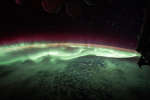 Aurora Slathers Up the Sky
14.01.2021
Like salsa verde on your favorite burrito, a green aurora slathers up the sky in this 2017 June 25 snapshot from the International Space Station. About 400 kilometers (250 miles) above Earth, the orbiting station is itself within the upper realm of the auroral displays.
 Barred Spiral Galaxy NGC 5335
26.04.2025
This stunning portrait of NGC 5335 was captured by the Hubble Space Telescope. Some 170,000 light-years across and over 200 million light-years away toward the constellation Virgo, the magnificent spiral galaxy is seen face-on in Hubble's view.
 APOD: 2025 September 14 Б Planets of the Solar System: Tilts and Spins
14.09.2025
How does your favorite planet spin? Does it spin rapidly around a nearly vertical axis, or horizontally, or backwards? The featured video animates NASA images of all eight planets in our Solar System to show them spinning side-by-side for an easy comparison.
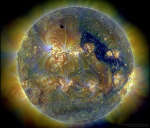 Venus and the Triply Ultraviolet Sun
6.03.2022
This was a very unusual type of solar eclipse. Typically, it is the Earth's Moon that eclipses the Sun. In 2012, though, the planet Venus took a turn. Like a solar eclipse by the Moon, the phase of Venus became a continually thinner crescent as Venus became increasingly better aligned with the Sun.
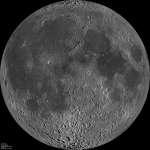 Lunar Nearside
3.03.2011
About 1,300 images from the Lunar Reconnaissance Orbiter spacecraft's wide angle camera were used to compose this spectacular view of a familiar face - the lunar nearside. But why is there a lunar nearside? The Moon rotates on its axis and orbits the Earth at the same rate, about once every 28 days.
|
January February March April May June July August September October |
|||||||||||||||||||||||||||||||||||||||||||||||||