
|
You entered: image
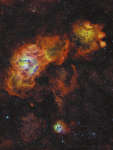 Sagittarius Sunflowers
23.06.2016
These three bright nebulae are often featured in telescopic tours of the constellation Sagittarius and the crowded starfields of the central Milky Way. In fact, 18th century cosmic tourist Charles Messier cataloged...
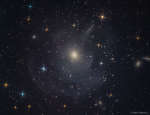 M89: Elliptical Galaxy with Outer Shells and Plumes
13.06.2017
Can you see them? This famous Messier object M89, a seemingly simple elliptical galaxy, is surrounded by faint shells and plumes. The cause of the shells is currently unknown, but possibly tidal tails related to debris left over from absorbing numerous small galaxies in the past billion years.
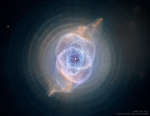 The Cats Eye Nebula from Hubble
9.06.2018
To some, it may look like a cat's eye. The alluring Cat's Eye nebula, however, lies three thousand light-years from Earth across interstellar space. A classic planetary nebula, the Cat's Eye (NGC 6543) represents a final, brief yet glorious phase in the life of a sun-like star.
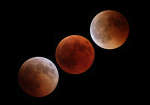 Central Lunar Eclipse
2.08.2018
Reddened by scattered sunlight, the Moon in the center is passing through the center of Earth's dark umbral shadow in this July 27 lunar eclipse sequence. Left to right the three images are from the start, maximum, and end to 103 minutes of totality from the longest lunar eclipse of the 21st century.
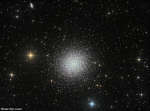 M13: The Great Globular Cluster in Hercules
3.08.2022
In 1716, English astronomer Edmond Halley noted, "This is but a little Patch, but it shows itself to the naked Eye, when the Sky is serene and the Moon absent." Of course...
 APOD: 2023 September 19 Б HH 211: Jets from a Forming Star
18.09.2023
Do stars always create jets as they form? No one is sure. As a gas cloud gravitationally contracts, it forms a disk that can spin too fast to continue contracting into a protostar. Theorists hypothesize that this spin can be reduced by expelling jets.
 APOD: 2024 April 8 Б The Changing Ion Tail of Comet Pons Brooks
7.04.2024
How does a comet tail change? It depends on the comet. The ion tail of Comet 12P/PonsБBrooks has been changing markedly, as detailed in the featured image sequenced over nine days from March 6 to 14 (top to bottom).
 Facing NGC 1232
17.04.2024
From our vantage point in the Milky Way Galaxy, we see NGC 1232 face-on. Nearly 200,000 light-years across, the big, beautiful spiral galaxy is located some 47 million light-years away in the flowing southern constellation of Eridanus. This sharp, multi-color, telescopic image of NGC 1232 includes remarkable details of the distant island universe.
 Xuyi Station and the Fireball
5.12.2024
Colorful and bright, this streaking fireball meteor was captured in a single exposure taken at Purple Mountain (Tsuchinshan) ObservatoryБs Xuyi Station in 2020, during planet Earth's annual Perseid meteor shower. The dome in the foreground houses the China Near Earth Object Survey Telescope (CNEOST), the largest multi-purpose Schmidt telescope in China.
 The Solar Eclipse Analemma Project
19.03.2025
Recorded from 2024 March 10, to 2025 March 1, this composited series of images reveals a pattern in the seasonal drift of the Sun's daily motion through planet Earth's sky. Known...
|
January February March April May June July August September |
|||||||||||||||||||||||||||||||||||||||||||||||||