
|
You entered: eclipse
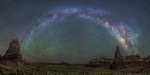 From the Temple of the Sun to the Temple of the Moon
7.10.2014
What connects the Sun to the Moon? Many answers have been given throughout history, but in the case of today's featured image, it appears to be the plane of our Milky Way Galaxy.
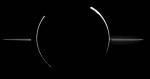 Jupiters Rings Revealed
16.06.2002
Why does Jupiter have rings? Jupiter's rings were discovered in 1979 by the passing Voyager 1 spacecraft, but their origin was a mystery. Data from the Galileo spacecraft currently orbiting Jupiter later confirmed that these rings were created by meteoroid impacts on small nearby moons.
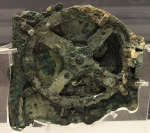 The Antikythera Mechanism
9.01.2011
What is it? It was found at the bottom of the sea aboard an ancient Greek ship. Its seeming complexity has prompted decades of study, although some of its functions remained unknown. Recent X-rays of the device have now confirmed the nature of the Antikythera mechanism, and discovered several surprising functions.
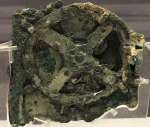 The Antikythera Mechanism
20.01.2013
What is it? It was found at the bottom of the sea aboard an ancient Greek ship. Its seeming complexity has prompted decades of study, although some of its functions remained unknown. X-ray images of the device have confirmed the nature of the Antikythera mechanism, and discovered several surprising functions.
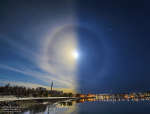 Sun and Moon Halo
3.04.2015
Two pictures captured on April 1 are combined in this creative day and night composite. Separated in time by about 10 hours the images otherwise match, looking along the coast at Östersund Sweden.
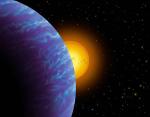 The Decade that Defined Star System
29.12.1999
As the 1990s began, the only planetary star system known was our own Solar System. The first extra-solar star system was discovered orbiting a pulsar in 1991. Slight changes in the precise arrival times of the pulses from the central small dense neutron star gave evidence of orbiting planets.
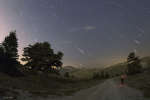 Perseid Meteors over Turkey
1.08.2017
The Perseid Meteor Shower, usually the best meteor shower of the year, will peak late next week. A person watching a clear sky from a dark location might see a bright meteor every minute.
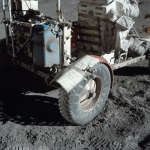 Lunar Dust and Duct Tape
28.03.2025
Why is the Moon so dusty? On Earth, rocks are weathered by wind and water, creating soil and sand. On the Moon, eons of constant micrometeorite bombardment have blasted away at the rocky surface creating a layer of powdery lunar soil or regolith.
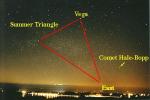 Vega
Vega
23.08.1998
Vega is a bright blue star 25 light years away. Vega is the brightest star in the Summer Triangle, a group of stars easily visible summer evenings in the northern hemisphere. The name Vega...
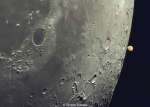 APOD: 2020 August 15 Б Mars at the Moons Edge
15.08.2020
Does the Moon ever block out Mars? Yes, the Moon occasionally moves in front of all of the Solar System's planets. Just this past Sunday, as visible from some locations in South America, a waning gibbous Moon eclipsed Mars.
|
January February March April May June July August |
||||||||||||||||||||||||||||||||||||||||||||||||||||||||