
|
You entered: dark
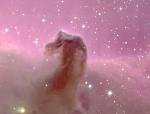 The Horsehead Nebula
16.12.2001
One of the most identifiable nebulae in the sky, the Horsehead Nebula in Orion, is part of a large, dark, molecular cloud. Also known as Barnard 33, the unusual shape was first discovered on a photographic plate in the late 1800s.
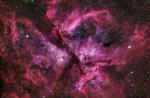 The Great Carina Nebula
27.10.2007
A jewel of the southern sky, the Great Carina Nebula, aka NGC 3372, spans over 300 light-years, one of our galaxy's largest star forming regions. Like the smaller, more northerly Orion Nebula...
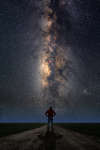 The Milky Road
13.06.2009
Inspired by the night skies of planet Earth in the International Year of Astronomy, photographer Larry Landolfi created this tantalizing fantasy view. The composited image suggests a luminous Milky Way is the heavenly extension of a country road.
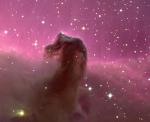 The Horsehead Nebula
19.05.1999
One of the most identifiable nebulae in the sky, the Horsehead Nebula in Orion, is part of a large, dark, molecular cloud. Also known as Barnard 33, the unusual shape was first discovered on a photographic plate in the late 1800s.
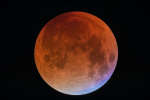 A Blue Blood Moon
3.10.2015
This sharp telescopic snapshot caught late September's Harvest Moon completely immersed in Earth's dark umbral shadow, at the beginning of a total lunar eclipse. It was the final eclipse in a tetrad, a string of four consecutive total lunar eclipses.
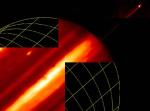 Jupiter: Moon, Ring, and Clouds
21.11.1997
An inner moon, an edge-on, planet-girdling ring, and high altitude cloud bands are visible in this mosaic of infrared images of gas giant Jupiter. The moon Metis, 25 miles wide and about 80,000 miles from the planet, is the bright spot at the upper right.
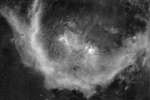 Barnards Loop around the Horsehead Nebula
24.02.2009
Why is the Horsehead Nebula surrounded by a bubble? Although hard to make out above, the famous Horsehead Nebula is the slight dark indentation in the bright streak just to the left of the image center. Glowing like an emission nebula, the origin of the bubble, known as Barnard's Loop, is currently unknown.
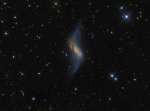 Polar Ring Galaxy NGC 660
22.01.2011
NGC 660 lies near the center of this intriguing skyscape, swimming in the boundaries of the constellation Pisces. Over 20 million light-years away, its peculiar appearance marks it as a polar ring galaxy.
 A Journey Through the Night Sky
20.05.2011
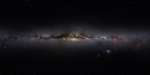
Majestic nebulae and stars of our Milky Way Galaxy stretch across this panoramic image of the entire night sky. At full resolution, the 5 gigapixel mosaic was stitched together from over 37,000 images...
 The Cygnus Wall of Star Formation
11.10.2016
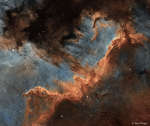
Sometimes, stars form in walls -- bright walls of interstellar gas. In this vivid skyscape, stars are forming in the W-shaped ridge of emission known as the Cygnus Wall. Part of a larger emission nebula with a distinctive outline popularly called The North America Nebula, the cosmic ridge spans about 20 light-years.
|
January February March April May June July August September |
|||||||||||||||||||||||||||||||||||||||||||||||||