
|
You entered: image
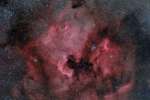 North America and the Pelican
3.09.2013
Here lie familiar shapes in unfamiliar locations. On the left is an emission nebula cataloged as NGC 7000, famous partly because it resembles our fair planet's continent of North America. The emission region to the right of the North America Nebula is IC 5070, also known for its suggestive outlines as the Pelican Nebula.
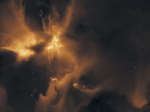 A Particle Beam Jet forms HH 24
4.02.2014
If you visit HH 24, don't go near the particle beam jet. This potential future travel advisory might be issued because the powerful jet likely contains electrons and protons moving hundreds of kilometers per second.
 Aurora Dog over Alaska
29.04.2014
Sometimes it is hard to believe what you see in the sky. While leading his annual aurora tour last month near Fairbanks in central Alaska, astrophotographer John Chumack and his company saw a most unusual aurora. This bright aurora appeared to change into the shape of a jumping dog, complete with a curly tail.
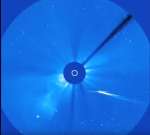 Comet ISON Being Destroyed by the Sun
2.11.2015
Most comets don't survive a close encounter with the Sun. Two years ago this month, though, Comet ISON was thought by some to be big enough to withstand its perilous sungrazing dive. The featured video shows the drama as it was recorded by NASA's Solar and Heliospheric Observatory (SOHO) satellite.
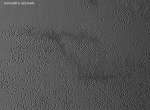 Unusual Pits Discovered on Pluto
25.11.2015
Why are there unusual pits on Pluto? The indentations were discovered during the New Horizons spacecraft's flyby of the dwarf planet in July. The largest pits span a kilometer across and dip tens...
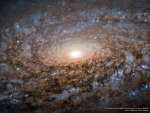 In the Center of Spiral Galaxy NGC 3521
30.11.2015
This huge swirling mass of stars, gas, and dust occurs near the center of a nearby spiral galaxy. Gorgeous spiral NGC 3521 is a mere 35 million light-years distant, toward the constellation Leo. Spanning some 50,000 light-years, its central region is shown in this dramatic image, constructed from data from the Hubble Space Telescope.
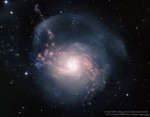 NGC 3310: A Starburst Spiral Galaxy
1.03.2016
The party is still going on in spiral galaxy NGC 3310. Roughly 100 million years ago, NGC 3310 likely collided with a smaller galaxy causing the large spiral galaxy to light up with a tremendous burst of star formation.
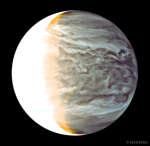 Night on Venus in Infrared from Orbiting Akatsuki
7.06.2016
Why is Venus so different from Earth? To help find out, Japan launched the robotic Akatsuki spacecraft which entered orbit around Venus late last year after an unplanned five-year adventure around the inner Solar System.
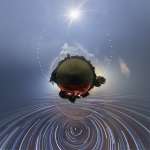 Little Planet Astro Camp
2.09.2016
Day and night on this little planet look a lot like day and night on planet Earth. In fact, the images used to construct the little planet projection, a digitally warped and stitched mosaic covering 360x180 degrees, were taken during day and night near Tarján, Hungary, planet Earth.
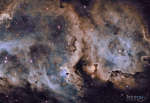 W5: The Soul of Star Formation
29.11.2016
Where do stars form? Many times, stars form in energetic regions where gas and dark dust are pushed around in chaotic mayhem. Pictured, bright massive stars near the center of W5, the Soul Nebula, are exploding and emitting ionizing light and energetic winds.
|
January February March April May June July August September |
|||||||||||||||||||||||||||||||||||||||||||||||||