
|
You entered: light
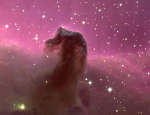 The Horsehead Nebula
21.10.2012
One of the most identifiable nebulae in the sky, the Horsehead Nebula in Orion, is part of a large, dark, molecular cloud. Also known as Barnard 33, the unusual shape was first discovered on a photographic plate in the late 1800s.
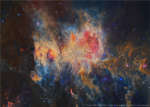 Infrared Orion from WISE
18.01.2015
The Great Nebula in Orion is an intriguing place. Visible to the unaided eye, it appears as a small fuzzy patch in the constellation of Orion. But this image, an illusory-color four-panel mosaic taken...
 NGC 7331 Close Up
6.02.2018
Big, beautiful spiral galaxy NGC 7331 is often touted as an analog to our own Milky Way. About 50 million light-years distant in the northern constellation Pegasus, NGC 7331 was recognized early on as a spiral nebula and is actually one of the brighter galaxies not included in Charles Messier's famous 18th century catalog.
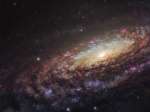 NGC 7331 Close Up
6.02.2020
Big, beautiful spiral galaxy NGC 7331 is often touted as an analog to our own Milky Way. About 50 million light-years distant in the northern constellation Pegasus, NGC 7331 was recognized early on as a spiral nebula and is actually one of the brighter galaxies not included in Charles Messier's famous 18th century catalog.
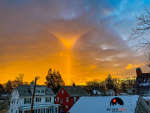 Sun Pillar with Upper Tangent Arc
16.02.2021
This was not a typical sun pillar. Just after sunrise two weeks ago in Providence, Rhode Island, USA, a photographer, looking out his window, was suddenly awestruck. The astonishment was caused by a sun pillar that fanned out at the top.
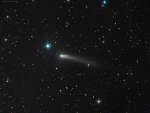 Rosetta's Comet in View
9.09.2021
Faint comet Churyumov-Gerasimenko (67P) sweeps past background stars in the constellation Taurus and even fainter distant galaxies in this telescopic frame from September 7. About 5 years ago, this comet's 4 kilometer spanning...
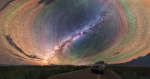 Colorful Airglow Bands Surround Milky Way
12.03.2022
Why would the sky glow like a giant repeating rainbow? Airglow. Now air glows all of the time, but it is usually hard to see. A disturbance however -- like an approaching storm -- may cause noticeable rippling in the Earth's atmosphere.
 A Hazy Harvest Moon
19.09.2024
For northern hemisphere dwellers, September's Full Moon was the Harvest Moon. On September 17/18 the sunlit lunar nearside passed into shadow, just grazing Earth's umbra, the planet's dark, central shadow cone, in a partial lunar eclipse.
 APOD: 2025 March 16 Б Venus and the Triply Ultraviolet Sun
15.03.2025
This was a very unusual type of solar eclipse. Typically, it is the Earth's Moon that eclipses the Sun. In 2012, though, the planet Venus took a turn. Like a solar eclipse by the Moon, the phase of Venus became a continually thinner crescent as Venus became increasingly better aligned with the Sun.
 APOD: 2025 September 24 Б GW250114: Rotating Black Holes Collide
23.09.2025
It was the strongest gravitational wave signal yet measured -- what did it show? GW250114 was detected by both arms of the Laser Interferometer Gravitational-wave Observatory (LIGO) in Washington and Louisiana USA earlier this year.
|
January February |
|||||||||||||||||||||||||||||||||||||||||||||||||