
|
You entered: massive stars
 Fermi Epicyles: The Vela Pulsar s Path
4.05.2012
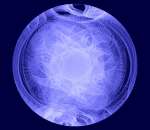
Exploring the cosmos at extreme energies, the Fermi Gamma-ray Space Telescope orbits planet Earth every 95 minutes. By design, it rocks to the north and then to the south on alternate orbits in order to survey the sky with its Large Area Telescope (LAT).
 Approaching the Bubble Nebula
31.05.2017
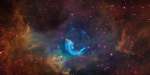
What would it look like to approach the Bubble Nebula? Blown by the wind and radiation from a massive star, this bubble now spans seven light-years in diameter. The hot star inside is thousands of times more luminous than our Sun, and is now offset from the nebula's center.
 In the Center of Reflection Nebula NGC 1333
21.05.2007
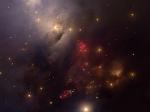
The dust is so thick in the center of NGC 1333 that you can hardly see the stars forming. Conversely, the very dust clouds that hide the stars also reflects their optical light, giving NGC 1333's predominantly blue glow the general designation of a reflection nebula.
 APOD: 2023 August 28 Б Star Formation in the Pacman Nebula
28.08.2023
Look through the cosmic cloud cataloged as NGC 281 and you might miss the stars of open cluster IC 1590. Formed within the nebula, that cluster's young, massive stars ultimately power the pervasive nebular glow.
 APOD: 2024 September 18 Б The Mermaid Nebula Supernova Remnant
18.09.2024
New stars are born from the remnants of dead stars. The gaseous remnant of the gravitational collapse and subsequent death of a very massive star in our Milky Way created the G296.5+10.0 supernova remnant, of which the featured Mermaid Nebula is part.
 APOD: 2026 January 19 Б CTB 1: The Medulla Nebula
19.01.2026
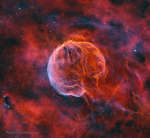
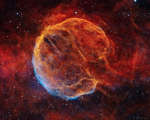
What powers this unusual nebula? CTB 1 is the expanding gas shell that was left when a massive star toward the constellation of Cassiopeia exploded about 10,000 years ago. The star likely detonated when it ran out of elements, near its core, that could create stabilizing pressure with nuclear fusion.
 The Medulla Nebula Supernova Remnant
18.01.2021
What powers this unusual nebula? CTB-1 is the expanding gas shell that was left when a massive star toward the constellation of Cassiopeia exploded about 10,000 years ago. The star likely detonated when it ran out of elements, near its core, that could create stabilizing pressure with nuclear fusion.
 APOD: 2025 March 26 Б Star Formation in the Pacman Nebula
26.03.2025
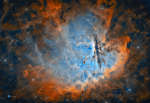
You'd think the Pacman Nebula would be eating stars, but actually it is forming them. Within the nebula, a cluster's young, massive stars are powering the pervasive nebular glow. The eye-catching shapes...
 NGC 602 and Beyond
16.05.2021
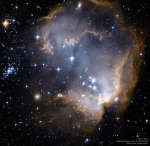
The clouds may look like an oyster, and the stars like pearls, but look beyond. Near the outskirts of the Small Magellanic Cloud, a satellite galaxy some 200 thousand light-years distant, lies 5 million year young star cluster NGC 602.
 APOD: 2023 April 24 Б The Medulla Nebula Supernova Remnant
24.04.2023
What powers this unusual nebula? CTB-1 is the expanding gas shell that was left when a massive star toward the constellation of Cassiopeia exploded about 10,000 years ago. The star likely detonated when it ran out of elements near its core that could create stabilizing pressure with nuclear fusion.
|
January February |
|||||||||||||||||||||||||||||||||||||||||||||||||