
|
You entered: dust
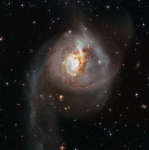 The Clash of NGC 3256
7.06.2018
Marked by an unusually bright central region, swirling dust lanes, and far flung tidal tails, peculiar NGC 3256 is the aftermath of a truly cosmic collision. The 500 million year old clash of two separate galaxies spans some 100 thousand light-years in this sharp Hubble view.
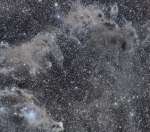 The Chameleon's Dark Nebulae
15.07.2009
The Chameleon is a small constellation near the south celestial pole. Boasting no bright stars, it blends inconspicuously with the starry southern sky. But, taken in dark skies over Namibia, this image reveals a stunning aspect of the shy constellation -- a field of dusty nebulae and colorful stars.
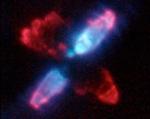 Shells in the Egg Nebula
26.06.1999
The Egg Nebula is taking a beating. Like a baby chick pecking its way out of an egg, the star in the center of the Egg Nebula is casting away shells of gas and dust as it slowly transforms itself into a white dwarf star.
 Fireworks and Shooting Stars
9.08.2002
Experimenting with a new telescope and camera, photographer Jim Steele captured this surreal but festive image of fireworks in the night sky above Ashland, Oregon. The date was July 4th and the fiery streaks were part of the traditional annual celebration of independence day in the United States.
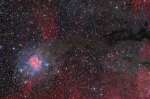 Cocoon Nebula Wide Field
13.09.2012
In this crowded starfield covering over 2 degrees within the high flying constellation Cygnus, the eye is drawn to the Cocoon Nebula. A compact star forming region, the cosmic Cocoon punctuates a long trail of obscuring interstellar dust clouds.
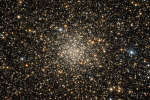 The Reddening of M71
9.12.2014
Now known to be a globular star cluster at the tender age of 10 billion years, M71 is a mere 13,000 light-years away within the narrow boundaries of the faint constellation Sagitta. Close...
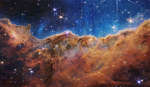 Carina Cliffs from the Webb Space Telescope
5.09.2022
Stars created these cliffs. Specifically, the destructive winds and energetic light from the stars in the open cluster NGC 3324 eroded away part of a mountain of dark interstellar dust in the northern part of the Carina Nebula.
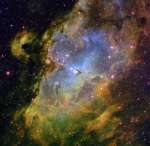 Inside the Eagle Nebula
16.02.2014
From afar, the whole thing looks like an Eagle. A closer look at the Eagle Nebula, however, shows the bright region is actually a window into the center of a larger dark shell of dust. Through this window, a brightly-lit workshop appears where a whole open cluster of stars is being formed.
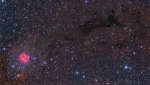 Cocoon Nebula Wide Field
18.09.2014
In this crowded starfield covering over 2 degrees within the high flying constellation Cygnus, the eye is drawn to the Cocoon Nebula. A compact star forming region, the cosmic Cocoon punctuates a long trail of obscuring interstellar dust clouds.
 M16: Inside the Eagle Nebula
28.12.2020
From afar, the whole thing looks like an Eagle. A closer look at the Eagle Nebula, however, shows the bright region is actually a window into the center of a larger dark shell of dust. Through this window, a brightly-lit workshop appears where a whole open cluster of stars is being formed.
|
January February March April May June July August September |
|||||||||||||||||||||||||||||||||||||||||||||||||