
|
You entered: dark cloud
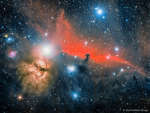 The Horsehead Nebula
6.10.2019
The Horsehead Nebula is one of the most famous nebulae on the sky. It is visible as the dark indentation to the red emission nebula in the center of the above photograph. The horse-head feature is dark because it is really an opaque dust cloud that lies in front of the bright red emission nebula.
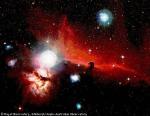 Orion's Horsehead Nebula
25.10.1997
The Horsehead Nebula is one of the most famous nebulae on the sky. It is visible as the black indentation to the red emission nebula seen just to the right of center of the above photograph. The bright star near the center is located in the belt of the familiar constellation of Orion.
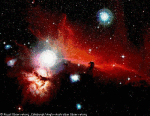 Orion's Horsehead Nebula
3.01.1999
The Horsehead Nebula is one of the most famous nebulae on the sky. It is visible as the black indentation to the red emission nebula seen just to the right of center of the above photograph. The bright star near the center is located in the belt of the familiar constellation of Orion.
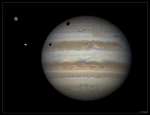 Shadows Across Jupiter
15.02.2013
Two dark shadows loom across the banded and mottled cloud tops of Jupiter in this sharp telescopic view. In fact, captured on January 3rd, about a month after the ruling gas giant appeared at opposition in planet Earth's sky, the scene includes the shadow casters.
 Scorpius Enhanced
16.06.2021
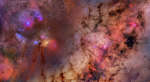
If Scorpius looked this good to the unaided eye, humans might remember it better. Scorpius more typically appears as a few bright stars in a well-known but rarely pointed out zodiacal constellation. To get a spectacular image like this, though, one needs a good camera, a dark sky, and some sophisticated image processing.
 Orion's Horsehead Nebula
2.10.1996
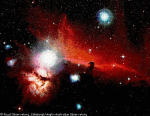
The Horsehead Nebula is arguably the most famous nebula on the sky. It is visible as the black indentation to the red emission nebula seen just to the right of center of the above photograph. The bright star near the center is located in the belt of the familiar constellation of Orion.
 In the Center of the Trifid Nebula
26.06.2002
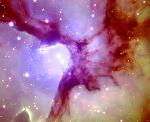
Clouds of glowing gas mingle with lanes of dark dust in the Trifid Nebula, a star forming region toward the constellation of Sagittarius. In the center, the three huge dark dust lanes that give the Trifid its name all come together.
 The Horsehead Nebula
16.12.2015
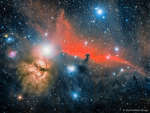
The Horsehead Nebula is one of the most famous nebulae on the sky. It is visible as the dark indentation to the red emission nebula in the center of the above photograph. The horse-head feature is dark because it is really an opaque dust cloud that lies in front of the bright red emission nebula.
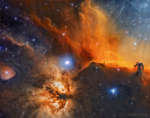 The Horsehead and Flame Nebulas
3.11.2021
The Horsehead Nebula is one of the most famous nebulae on the sky. It is visible as the dark indentation to the orange emission nebula at the far right of the featured picture. The horse-head feature is dark because it is really an opaque dust cloud that lies in front of the bright emission nebula.
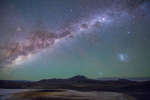 Galaxies from the Altiplano
13.10.2016
The central bulge of our Milky Way Galaxy rises over the northern Chilean Atacama altiplano in this postcard from planet Earth. At an altitude of 4500 meters, the strange beauty of the desolate landscape could almost belong to another world though.
|
January February March April May June July August September |
|||||||||||||||||||||||||||||||||||||||||||||||||