
|
You entered: composite image
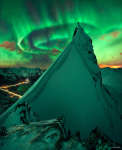 APOD: 2023 January 22 Б In Green Company: Aurora over Norway
21.01.2023
Raise your arms if you see an aurora. With those instructions, two nights went by with, well, clouds -- mostly. On the third night of returning to same peaks, though, the sky not only cleared up but lit up with a spectacular auroral display.
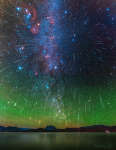 Geminids from Gemini
15.11.2021
Where are all of these meteors coming from? In terms of direction on the sky, the pointed answer is the constellation of Gemini. That is why the major meteor shower in December is known as the Geminids -- because shower meteors all appear to come from a radiant toward Gemini.
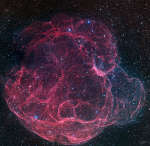 Simeis 147: Supernova Remnant
20.11.2019
It's easy to get lost following the intricate looping filaments in this detailed image of supernova remnant Simeis 147. Also cataloged as Sharpless 2-240 it goes by the popular nickname, the Spaghetti Nebula.
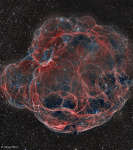 Simeis 147: Supernova Remnant
9.12.2020
It's easy to get lost following the intricate looping filaments in this detailed image of supernova remnant Simeis 147. Also cataloged as Sharpless 2-240 it goes by the popular nickname, the Spaghetti Nebula.
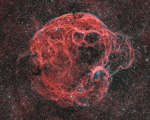 Supernova Remnant Simeis 147
12.01.2022
It's easy to get lost following the intricate, looping, twisting filaments in this detailed image of supernova remnant Simeis 147. Also cataloged as Sharpless 2-240 it goes by the popular nickname, the Spaghetti Nebula.
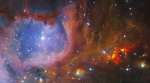 Messier 43
9.07.2015
Often imaged but rarely mentioned, Messier 43 is a large star forming region in its own right. It's just part of the star forming complex of gas and dust that includes the larger, more famous neighboring Messier 42, the Great Orion Nebula.
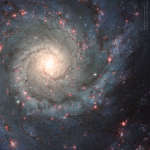 A Perfect Spiral
12.08.2021
If not perfect then this spiral galaxy is at least one of the most photogenic. An island universe of about 100 billion stars, 32 million light-years away toward the constellation Pisces, M74 presents a gorgeous face-on view.
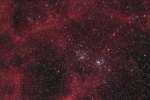 Double Cluster in Perseus
23.01.2014
This lovely starfield spans some seven full moons (about 3.5 degrees) across the heroic northern constellation of Perseus. Just right of center it holds the famous pair of open or galactic star clusters, h and Chi Perseii.
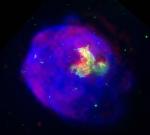 Structure in N63A
31.12.2003
Shells and arcs abound in this false-color, multiwavelength view of supernova remnant N63A, the debris of a massive stellar explosion. The x-ray emission (blue), is from gas heated to 10 million degrees C as knots of fast moving material from the cosmic blast sweep up surrounding interstellar matter.
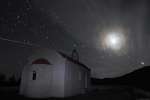 Atlantis over Rhodes
28.05.2010
A moonlit chapel stands in the foreground of this night-scape from the historic Greek island of Rhodes. The tantalizing sky above features a colorful lunar corona, where bright moonlight is diffracted by water droplets in the thin clouds drifting in front of the lunar disk.
|
January February March April May June July August September |
|||||||||||||||||||||||||||||||||||||||||||||||||