
|
You entered: Milky Way
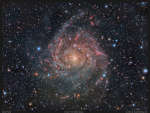 IC 342: The Hidden Galaxy in Camelopardalis
11.02.2022
Similar in size to large, bright spiral galaxies in our neighborhood, IC 342 is a mere 10 million light-years distant in the long-necked, northern constellation Camelopardalis. A sprawling island universe, IC 342 would otherwise...
 IC 342: Hidden Galaxy in Camelopardalis
22.11.2023
Similar in size to large, bright spiral galaxies in our neighborhood, IC 342 is a mere 10 million light-years distant in the long-necked, northern constellation Camelopardalis. A sprawling island universe, IC 342 would otherwise...
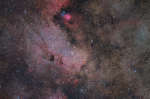 Messier 24: Sagittarius Star Cloud
18.07.2024
Unlike most entries in Charles Messier's famous catalog of deep sky objects, M24 is not a bright galaxy, star cluster, or nebula. It's a gap in nearby, obscuring interstellar dust clouds that allows a view of the distant stars in the Sagittarius spiral arm of our Milky Way galaxy.
 Galaxies in Space
8.03.2025
The plane of our Milky Way galaxy extends beyond the limb of planet Earth in this space age exposure captured by astronaut Don Pettit. His camera, with low light and long duration settings, was pointed out the window of a Dragon crew spacecraft docked with the International Space Station on January 29.
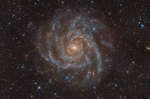 IC 342: Hidden Galaxy in Camelopardalis
8.01.2026
Similar in size to large, bright spiral galaxies in our neighborhood, IC 342 is a mere 10 million light-years distant toward the long-necked, northern constellation Camelopardalis. A sprawling island universe, IC 342 would otherwise...
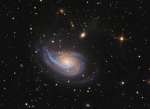 Arp 78: Peculiar Galaxy in Aries
7.07.2011
Peculiar spiral galaxy Arp 78 is found within the boundaries of the head strong constellation Aries, some 100 million light-years beyond the stars and nebulae of our Milky Way galaxy. Also known...
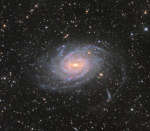 Spiral Galaxy NGC 6744
5.12.2019
Beautiful spiral galaxy NGC 6744 is nearly 175,000 light-years across, larger than our own Milky Way. It lies some 30 million light-years distant in the southern constellation Pavo and appears as only a faint, extended object in small telescopes.
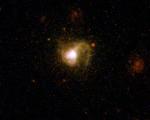 POX 186: Not So Long Ago
3.01.2003
Not so long ago and not so far, far away, a galaxy was born. Seen in this Hubble Space Telescope image, the island universe of stars, gas, and dust cataloged as POX 186 is a mere 68 million light-years distant toward an uncrowded region in the constellation Virgo.
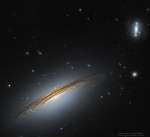 UGC 12591: The Fastest Rotating Galaxy Known
19.02.2020
Why does this galaxy spin so fast? To start, even identifying which type of galaxy UGC 12591 is difficult -- featured on the lower left, it has dark dust lanes like a spiral galaxy but a large diffuse bulge of stars like a lenticular.
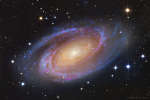 Bright Spiral Galaxy M81
18.11.2014
One of the brightest galaxies in planet Earth's sky is similar in size to our Milky Way Galaxy: big, beautiful M81. This grand spiral galaxy can be found toward the northern constellation of the Great Bear (Ursa Major).
|
January February March April May June July August September October |
|||||||||||||||||||||||||||||||||||||||||||||||||