
|
You entered: stellar nursery
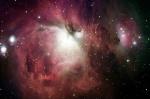 The Orion Nebula in Hydrogen
22.11.2000
The Great Nebula in Orion can be found just below and to the left of the easily identifiable belt of three stars in the popular constellation Orion. This fuzzy patch, visible to the unaided eye, contains one of the closest stellar nurseries, lying at a distance of about 1500 light years.
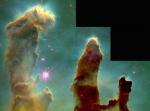 M16: Stars from Eagle's EGGs
25.11.2001
Newborn stars are forming in the Eagle Nebula. This image, taken with the Hubble Space Telescope in 1995, shows evaporating gaseous globules (EGGs) emerging from pillars of molecular hydrogen gas and dust. The giant pillars are light years in length and are so dense that interior gas contracts gravitationally to form stars.
 M16: Stars from Eagle's Eggs
24.09.2000
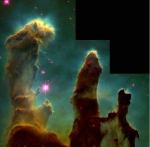
Newborn stars are forming in the Eagle Nebula. This image, taken with the Hubble Space Telescope in 1995, shows evaporating gaseous globules (EGGs) emerging from pillars of molecular hydrogen gas and dust. The giant pillars are light years in length and are so dense that
 M16: Stars from Eagles EGGs
26.10.2003
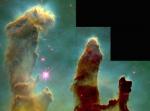
Newborn stars are forming in the Eagle Nebula. This image, taken with the Hubble Space Telescope in 1995, shows evaporating gaseous globules (EGGs) emerging from pillars of molecular hydrogen gas and dust. The giant pillars are light years in length and are so dense that interior gas contracts gravitationally to form stars.
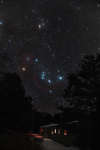 Northern Winter Night
25.12.2020
Orion always seems to come up sideways on northern winter evenings. Those familiar stars of the constellation of the Hunter are caught above the trees in this colorful night skyscape. Not a star at all but still visible to eye, the Great Nebula of Orion shines below the Hunter's belt stars.
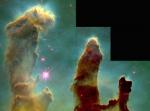 M16: Stars from Eagle's EGGs
24.04.2005
Newborn stars are forming in the Eagle Nebula. This image, taken with the Hubble Space Telescope in 1995, shows evaporating gaseous globules (EGGs) emerging from pillars of molecular hydrogen gas and dust. The giant pillars are light years in length and are so dense that interior gas contracts gravitationally to form stars.
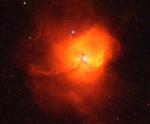 N81: Starbirth in the SMC
27.07.1998
A very young star cluster has been discovered in a neighboring galaxy. The stars found in this cluster, dubbed N81, are so young and massive that they furiously eject matter and light up the surrounding nebula. The ejected stellar winds combine and interact to sculpt beautiful and complex structures.
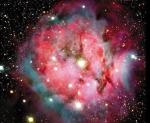 IC 5146: The Cocoon Nebula
14.10.2002
How did this nebula get created? The Cocoon Nebula, cataloged as IC 5146, is a strikingly beautiful nebula located about 4,000 light years away toward the constellation of Cygnus. Inside the Cocoon is a newly developing open cluster of stars.
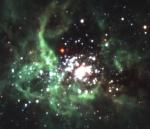 Tarantula
4.06.1997
NGC 2070 is an immense star forming region in a nearby galaxy known as the Large Magellanic Cloud. Its spidery appearance is responsible for its popular name, "The Tarantula Nebula", except that this tarantula is about 1,000 light-years across, and 165,000 light-years away in the southern constellation Dorado.
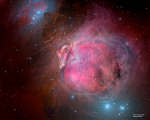 The Great Turkey Nebula
26.11.2020
Surprisingly reminiscent of The Great Nebula in Orion, The Great Turkey Nebula spans this creative field of view. Of course if it were the Orion Nebula it would be our closest large stellar nursery, found at the edge of a large molecular cloud a mere 1,500 light-years away.
|
January February March April May June July August September |
|||||||||||||||||||||||||||||||||||||||||||||||||