
|
You entered: satellite
 Stellar Streams in the Local Universe
27.09.2024
The twenty galaxies arrayed in these panels are part of an ambitious astronomical survey of tidal stellar streams. Each panel presents a composite view; a deep, inverted image taken from publicly available imaging surveys of a field that surrounds a nearby massive galaxy image.
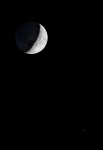 Jupiter and the Moons
5.10.2019
After sunset on October 3, some of the Solar System's largest moons stood low along the western horizon with the largest planet. Just after nightfall, a pairing of the Moon approaching first quarter phase and Jupiter was captured in this telephoto field of view.
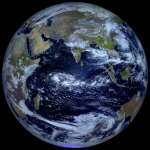 Equinox Earth
28.09.2013
From a geostationary orbit 36,000 kilometers above the equator, Russian meteorological satellite Elektro-L takes high-resolution images our fair planet every 30 minutes. But only twice a year, during an Equinox, can it capture an image like this one, showing an entire hemisphere bathed in sunlight.
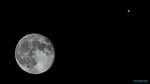 Moons and Jupiter
3.03.2016
Some of the Solar System's largest moons rose together on February 23. On that night, a twilight pairing of a waning gibbous Moon and Jupiter was captured in this sharp telescopic field of view.
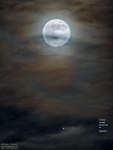 Moons and Jupiter
13.04.2017
On April 10, a Full Moon and Jupiter shared this telephoto field of view. Both were near opposition, opposite the Sun in Earth's night sky. Captured when a passing cloud bank dimmmed...
 A Tether in Space
7.01.2018
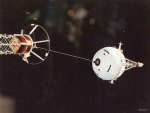
One of the greatest unrequited legends of outer space is the tether. Tethers, long strands of material, hold the promise of stabilizing satellites, generating electricity, and allowing easy transportation. Possibly the most ambitious vision of the space tether is the space elevator popularized by Arthur C.
 Sky Full of SARs
17.08.2024
On August 11 a Rocket Lab Electron rocket launched from a rotating planet. With a small satellite on board its mission was dubbed A Sky Full of SARs (Synthetic Aperture Radar satellites), departing for low Earth orbit from Mahia Peninsula on New Zealand's north island.
 The Flare and the Galaxy
2.09.2015
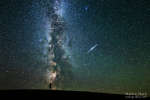
Is this person throwing a lightning bolt? No. Despite appearances, this person is actually pointing in the direction of a bright Iridium flare, a momentary reflection of sunlight off of a communications satellite in orbit around the Earth.
 Six Moons of Saturn
14.04.2012
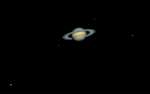
How many moons does Saturn have? So far 62 have been discovered, the smallest only a fraction of a kilometer across. Six of its largest satellites can be seen here, though, in a sharp Saturnian family portrait taken on March 9.
 NGC 147 and NGC 185
4.11.2021
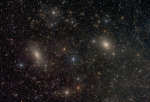
Dwarf galaxies NGC 147 (left) and NGC 185 stand side by side in this sharp telescopic portrait. The two are not-often-imaged satellites of M31, the great spiral Andromeda Galaxy, some 2.5 million light-years away.
|
January February March April May June July August September October |
|||||||||||||||||||||||||||||||||||||||||||||||||