
|
You entered: red dwarf
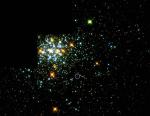 NGC 1818: Pick A Star
31.05.2003
This is NGC 1818, a youthful, glittering cluster of 20,000 stars residing in the Large Magellanic Cloud, 180,000 light-years away. Pick a star. Any star. Astronomers might pick the unassuming bluish-white one (circled) which appears to be a hot newly formed white dwarf star. What makes it so interesting?
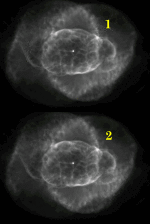 The Incredible Expanding Cats Eye
16.09.1999
Watch closely. As this animation blinks between two Hubble Space Telescope images of NGC 6543 - the first from 1994 and the second from 1997 - the intricate filaments of this nebula are seen to shift. The shift is due to the actual expansion of this gaseous shroud shed by a dying star!
 APOD: 2024 April 30 Б GK Per: Nova and Planetary Nebula
30.04.2024
The star system GK Per is known to be associated with only two of the three nebulas pictured. At 1500 light years distant, Nova Persei 1901 (GK Persei) was the second closest nova yet recorded. At the very center is a white dwarf star, the surviving core of a former Sun-like star.
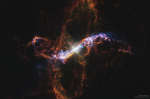 Symbiotic R Aquarii
11.07.2018
You can see it change in brightness with just binoculars over the course of a year. Variable star R Aquarii is actually an interacting binary star system, two stars that seem to have a close, symbiotic relationship.
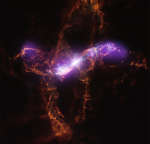 Symbiotic R Aquarii
5.02.2022
Variable star R Aquarii is actually an interacting binary star system, two stars that seem to have a close symbiotic relationship. Centered in this space-based optical/x-ray composite image it lies about 710 light years away.
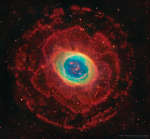 Rings Around the Ring Nebula
18.08.2021
The Ring Nebula (M57), is more complicated than it appears through a small telescope. The easily visible central ring is about one light-year across, but this remarkably deep exposure - a collaborative effort combining data from three different large telescopes - explores the looping filaments of glowing gas extending much farther from the nebula's central star.
 APOD: 2024 April 28 Б Rings Around the Ring Nebula
28.04.2024
The Ring Nebula (M57) is more complicated than it appears through a small telescope. The easily visible central ring is about one light-year across, but this remarkably deep exposure - a collaborative effort combining data from three different large telescopes - explores the looping filaments of glowing gas extending much farther from the nebula's central star.
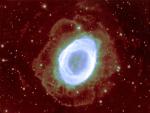 Halos Around the Ring Nebula
22.09.1999
What's happened to the Ring Nebula? The familiar Ring that can be seen with a small back-yard telescope takes on a new look when viewed in dim light. The above recently-released, false-color image...
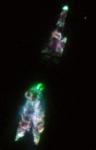 Emerging Planetary Nebula CRL 618
6.09.2000
CRL 618 may look to some like an Olympian declaring victory. Only a few hundred years ago, however, CRL 618 appeared as a relatively modest red giant star. Since then it has run out of core material to fuse and so has started to become a planetary nebula.
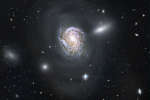 NGC 4911: Spiral Diving into a Dense Cluster
8.09.2010
Why are there faint rings around this spiral galaxy? Possibly because the galaxy, NGC 4911, is being pulled at by its neighbors as it falls into the enormous Coma Cluster of Galaxies.
|
January February March April May June July August September October |
|||||||||||||||||||||||||||||||||||||||||||||||||